Author: ekelola

  • AI vs Chess Logic: When Perfect Information Meets Imperfect Language

    AI vs Chess Logic: When Perfect Information Meets Imperfect Language

    Spread the love

    “Language is a soft mirror reflecting a hard reality — and sometimes it bends the board.”

    1. The Experiment

    The question was simple — or so it seemed:

    “In chess, after a white pawn move, a black knight move and a white knight move, how many possible legal positions are possible?”

    Three AI engines were asked this question:

    • ChatGPT answered 244
    • Claude Sonnet 4 answered 256
    • Gemini 2.5 Pro answered 5,362

    Three minds.
    One prompt.
    Three truths.

    2. The Logic Behind the Differences

    Each system saw the same question through a different philosophical lens.

    AI Model Interpretation Result Thought Pattern
    ChatGPT Simulated reasoning — move-by-move legality, contextual awareness 244 Human-like logical approximation
    Claude Sonnet 4 Simplified combinatorics — assumed independence of moves 256 Clean, elegant, slightly naïve logic
    Gemini 2.5 Pro Enumerative — counted all legal 3-ply chess positions 5,362 Database-driven pattern expansion

    Each was correct within its own frame of logic — but none reflected the absolute truth of chess.

    3. The Heart of the Confusion: Ambiguity in Language

    Chess is binary: a move is legal or it is not.
    Language is probabilistic: meaning depends on interpretation.

    The phrase “possible legal positions” contains at least four layers of ambiguity:

    1. Are we counting unique board arrangements or unique move sequences?
    2. Are all knight moves included, or only those unblocked by previous pawn moves?
    3. Do we allow transpositions (different paths to the same board)?
    4. Is “legal” defined strictly by chess rules, or relaxed as pseudo-legal moves?

    Each AI “heard” the question differently — because language itself is a spectrum of meanings, not a coordinate system.

    4. Chess as a Mirror for AI Reasoning

    Chess represents perfect information, but language models represent imperfect interpretation.

    Domain Chess Engine AI Language Model
    Nature Deterministic Probabilistic
    Knowledge Type State-based Semantic
    Representation Board coordinates Words and context
    Goal Accuracy Plausibility
    Truth System Binary Gradient

    A chess engine computes truth through enumeration.
    A language model constructs meaning through approximation.

    So when you ask an LLM a chess problem, you are really asking it to translate certainty into probability — and the translation always adds noise.

    5. The Philosophy of Divergence

    The divergence between 244, 256, and 5,362 isn’t just computational.
    It’s philosophical.

    • ChatGPT reasoned like a human teacher.
    • Claude reasoned like a mathematician.
    • Gemini reasoned like a statistical historian.

    Each built its own small universe of truth — coherent inside, incompatible outside.
    This mirrors human epistemology itself: knowledge isn’t a single mountain, but a constellation of hills.

    6. When Perfect Games Meet Imperfect Language

    Chess doesn’t lie.
    Language does — gently, eloquently, and often by accident.

    AI systems live in the space between certainty and expression.
    They don’t “see” the board; they see patterns of meaning about the board.

    And so, when asked for the number of possible positions, each model returns not the truth, but a reflection of how it understands truth.

    đŸ”č Insight

    AI’s challenge with chess isn’t about computation — it’s about comprehension.
    A chess engine calculates reality; a language model imagines it.
    And between calculation and imagination lies the philosophical gap where all intelligence — human or artificial — must learn to live.

    7. Wittgenstein and the Limits of Language

    “The limits of my language mean the limits of my world.” — Ludwig Wittgenstein, Tractatus Logico-Philosophicus

    Wittgenstein believed that thought and language are inseparable.
    In his Tractatus, he argued that anything we cannot express in language lies beyond reasoning.
    Applied to chess, this means our capacity to conceptualize or even notice a strategic idea depends on whether it can be named.

    We talk about pins, forks, and open files,
    but if a pattern has no word, it often escapes awareness altogether.
    AI, built upon human reasoning, therefore inherits our linguistic constraints — it can only model what we can describe.

    Decades later, in his Philosophical Investigations, Wittgenstein reimagined meaning as use within context.
    He famously remarked, “If a lion could speak, we would not understand him.”
    Language gains meaning only through shared activity — through what he called forms of life.

    Chess, in this view, is itself a language-game.
    Knowing the word king or checkmate tells you nothing unless you’ve played.
    Understanding arises not from definition but from participation.

    This illuminates our three AI answers:
    Each model interpreted the same question within its own language-game.
    To ChatGPT, “possible positions” meant one thing; to Claude, another; to Gemini, something else entirely.
    Each answer was internally logical but contextually isolated — a perfect echo of Wittgenstein’s insight that “no description can fully capture reality.”

    The essence of a profound chess idea — a sacrifice, a positional tension — can be felt over the board, yet remain ineffable in language.
    Here, Wittgenstein’s closing remark from the Tractatus whispers again:

    “Whereof one cannot speak, thereof one must be silent.”

    In that silence lies the boundary between computation and comprehension —
    between logic and the ineffable art that even machines cannot name.


    đŸȘ¶ Reflective Summary

    Wittgenstein’s philosophy reminds us that AI’s struggle with chess is not a failure of logic,
    but a reflection of language’s imperfection.
    We built AI from words — and words, like mirrors, always distort the light that passes through them.

    When AI meets chess, it does not just play a game.
    It performs a linguistic translation —
    from the certainty of moves to the uncertainty of meaning.
    And in that fragile translation,
    the machine becomes human after all.

  • A Bookmark of Sorrow: The Damilola Taylor Tragedy and its Echoes

    A Bookmark of Sorrow: The Damilola Taylor Tragedy and its Echoes

    Spread the love

    On a grey November afternoon in 2000, a ten-year-old boy named Damilola Taylor left Peckham Library in South London to walk home.
    He never made it. Minutes later, Damilola lay bleeding in a stairwell of the North Peckham Estate, fatally wounded by a broken bottle that severed an artery in his leg.

    His death stunned Britain — and the world. The killing of this bright Nigerian schoolboy became one of the UK’s most haunting tragedies.
    The image of a smiling child lost to youth violence cut deep, opening national conversations about the safety of children, the state of inner-city communities, and the fragile experience of Black youth in Britain’s urban landscape.
    From Peckham to Lagos, the pain rippled outward.

    The Burden of Grief and a Legacy of Hope

    For Damilola’s family, the pain was immeasurable and enduring.
    His father, Richard Taylor, would later admit that “life has been nothing but hell” since losing his young son.
    His mother, Gloria, collapsed under the weight of grief — her heart and body could no longer bear it.

    Yet out of this abyss, Richard and Gloria founded the Damilola Taylor Trust, turning pain into purpose.
    The charity became a vessel for their son’s unrealised dream — to “remould the world.”
    Through youth programs and anti-knife campaigns, the Taylors sought to spare other families such agony and to keep Damilola’s light alive.

    At his funeral, Damilola’s own poem was read aloud — a ten-year-old’s prophecy of hope:

    “I will travel far and wide to choose my destiny and remould the world.”

    That poem became his father’s armour. “He left it behind for me,” Richard said, “so I have to finish the work he began.”

    In 2020, two decades after the tragedy, Damilola’s birthday — December 7th — was declared a Day of Hope across the UK.
    Out of sorrow, a legacy: the hope of a child carried forward by a nation.

    Youth, Violence, and the Question of Maturity

    Damilola’s killers were children too — brothers Danny and Ricky Preddie, aged only twelve and thirteen.
    They were products of poverty, neglect, and peer-pressure, hardened too early by streets that mistook fear for respect.
    In Damilola’s innocence and the brothers’ brutality, we glimpse the dual faces of Black boyhood in early-2000s Britain — the dreamer and the survivor, the scholar and the street-soldier.

    Actor John Boyega, who had known Damilola, said the murder was “a shock to understand how mortality worked” at such a young age.
    He recalled how Damilola’s ambitions — to “impact the world” — felt foreign yet inspiring to boys their age.
    The contrast between their tender years and the violence that ended one of them became a mirror reflecting the pressures that forced many young Black men to grow up in armour long before they should have needed it.

    Justice, Mercy, and the Morality of Handling Child Killers

    When the Preddie brothers were finally convicted of manslaughter in 2006, they received eight-year sentences.
    The judge weighed the horror of the act against the youth of the offenders.
    Legally, justice was served; morally, the wound remained open.

    Richard Taylor could not forgive.
    “They have never shown remorse,” he said. “How can you forgive what has not been confessed?”
    His words echo the ancient tension between justice and mercy, between the Old Testament cry for retribution and Christ’s impossible call to forgive “seventy times seven.”

    The system’s mercy sought rehabilitation; the family’s pain demanded repentance.
    Neither side found peace.
    And perhaps that is the truest reflection of human justice — always partial, always reaching for what only heaven can complete.

    Medusa’s Stare: Mythology Meets Modern Tragedy

    To face such horror, we often reach for myth.
    In the tale of Perseus and Medusa, a hero confronts a monster whose gaze turns men to stone.
    Perseus survives only by looking at her reflection in a mirrored shield — slaying her without losing his own humanity.

    In Damilola’s story, Medusa is youth violence itself — a monstrosity born of neglect and fear, capable of freezing entire communities in despair.
    Richard Taylor becomes a kind of Perseus — not meeting rage with rage, but holding up the mirror of reflection, campaigning, teaching, and healing.
    His shield is memory; his weapon, hope.

    Just as Athena later bore Medusa’s head upon her shield as protection, Damilola’s story now adorns Britain’s conscience as a warning and a guard.
    The horror has been transformed into a symbol of vigilance — a call to protect what innocence remains.

    A Bookmark in History – Pain, Memory, and Progress

    A bookmark marks a pause — a place we cannot forget.
    Damilola’s death is a bookmark in the national story: the page where innocence was lost and reflection began.
    Each new youth stabbing re-opens that page.

    He was walking home from a library that day — perhaps carrying a book still open, a story unfinished.
    That image, of a child’s page left unturned, is the purest metaphor for his life.
    A bookmark left between promise and reality.

    Richard Taylor’s ongoing work, the annual Day of Hope, and the foundation’s projects are living bookmarks — reminders that grief can be transmuted into service, that memory can become motion.

    “There is a time to mourn and a time to mend.” — Ecclesiastes 3:7

    The story of Damilola is both: a tear and a mend, a pause and a turning.
    It marks where we stopped — and where we must continue.

    đŸȘ¶ Reflective Summary

    Damilola Taylor’s story remains a poignant bookmark in Britain’s moral history.
    It challenges us to measure the distance between justice and mercy, anger and forgiveness, despair and hope.
    Through the lens of myth, memory, and faith, his tragedy becomes more than an account of violence — it becomes a mirror.
    In that reflection we see not only a fallen child, but the society that failed him, and the possibility of one that might yet change.

    His own words guide the closing line:

    “I will travel far and wide to choose my destiny and remould the world.”
    Though the boy is gone, the work continues — each of us holding a place in the story he began.

  • Web Development vs Software Development: Two Branches of the Same Tree

    Web Development vs Software Development: Two Branches of the Same Tree

    Spread the love

    If you’ve ever wondered whether web developers and software developers are speaking the same language — the answer is: mostly yes, but with different accents.

    They both live in the same digital universe, but one prefers to build shiny spaceships (websites) that glide through the browser galaxy, while the other constructs entire planets (software systems) with gravity, atmosphere, and sometimes a few bugs pretending to be life forms.

    đŸ§© The Core Difference

    Aspect Web Development Software Development
    Definition Building and maintaining websites and web apps that live in browsers. Creating programs and systems that run on desktops, servers, mobile devices, or embedded hardware.
    Primary Platform Web browsers (Chrome, Safari, Edge, etc.) Any platform (Windows, macOS, Linux, iOS, Android, embedded chips).
    Languages & Tools HTML, CSS, JavaScript, TypeScript, React, Angular, Node.js, PHP, Python, etc. C#, Java, C++, Python, Swift, Go, Rust, Kotlin, etc.
    Deployment Uploaded to a web server and accessed via URLs. Installed, compiled, or distributed as executable software or apps.
    Focus User experience, responsiveness, interactivity, accessibility. Performance, logic, scalability, and platform-specific integration.

    In simple terms:

    Web development builds what you see and click; software development builds what you use and rely on — sometimes quietly humming in the background like a digital butler.

    🌐 Web Development: The Browser Kingdom

    Web developers are like architects of digital storefronts and interactive worlds.
    They live by three sacred scrolls: HTML, CSS, and JavaScript — the holy trinity that powers nearly every site you visit.

    They also speak modern dialects:

    • Front-End: The art of visual design and interactivity (React, Vue, Angular).
    • Back-End: The logic, data, and security (Node.js, .NET, Django, Flask).
    • Full-Stack: The brave souls who attempt both, often fuelled by coffee and Stack Overflow. ☕

    Example:
    Creating an e-commerce website that allows you to browse, shop, and checkout — all from your browser — without installing anything.

    Web developers spend their days making sure your shopping cart doesn’t explode when you add a coupon code.

    đŸ’» Software Development: The Wider Cosmos

    Software developers are explorers of a much bigger universe.
    While web developers build things on the web, software developers build things for the world.

    They work on:

    • Desktop software (like Photoshop or VS Code)
    • Mobile apps (WhatsApp, Spotify)
    • Operating systems and drivers
    • Embedded systems (the code running in your smartwatch or your toaster — yes, even that might be running Linux)

    A software developer might build the tools that web developers use to build websites — talk about meta.

    They think in terms of systems, processes, and performance — less “make this button look pretty,” and more “make this algorithm run 1,000× faster.”

    🔍 Where They Overlap

    Like two genres of music sharing a beat, web and software development often remix together.

    Modern apps (like Slack, Discord, or Notion) blur the line — they look like websites, but run as desktop software built with web technologies (hello, Electron).

    Both worlds share:

    • Version control (Git)
    • Testing and CI/CD pipelines
    • API communication
    • Cloud integration

    It’s fair to say that web development is a subset of software development, much like the web itself is a subset of the digital universe.

    🧠 A Philosophical Interlude

    If software development is the tree of creation, web development is one of its most expressive branches — the one facing the sunlight, connecting with humans directly.

    Every click, animation, and pixel you see is the tree whispering: “Hey human, look what I can do.”
    Meanwhile, deep underground, software development forms the roots and trunk — the unseen infrastructure holding everything upright and stable.

    Without the roots, there’s no bloom.
    Without the bloom, there’s no wonder.

    💡 Analogy Time

    Think of software development as the field of architecture — it covers everything from designing skyscrapers to submarines.
    Web development is like building a beautiful glass café that anyone can walk into from anywhere in the world, as long as they have a browser and Wi-Fi.

    One shapes the skyline.
    The other invites you in for coffee and conversation.

    😂 The TL;DR (too long; didn’t read) Version

    • A software developer might build the engine, transmission, and navigation system.

    Think big systems.

    • A web developer designs the dashboard, touchscreen, and the Spotify playlist that makes the ride feel good.

    Think small machines.

    • Both are vital — because a car without style is boring, and a car without an engine is a very expensive sculpture.

    🚀 Final Thought

    Web development and software development are not rivals — they’re siblings in the same digital family.
    One focuses on the human interface, the other on the machinery beneath.
    Together, they make technology both usable and magical.

    So whether you’re painting pixels or pushing packets, you’re part of the same grand narrative:

    turning abstract logic into living experience.

  • Black History Month: Memory, Motion, and the Quiet Revolution of Being Seen

    Black History Month: Memory, Motion, and the Quiet Revolution of Being Seen

    Spread the love

    1. “I am my ancestors’ wildest dreams.” — Anonymous

    2. “The function of freedom is to free someone else.” — Toni Morrison

    3. “My humanity is bound up in yours, for we can only be human together.” — Desmond Tutu

    4. “If there is no struggle, there is no progress.” — Frederick Douglass

    5. “Not everything that is faced can be changed, but nothing can be changed until it is faced.” — James Baldwin

    6. “You may not control all the events that happen to you, but you can decide not to be reduced by them.” — Maya Angelou

    7. “The most common way people give up their power is by thinking they don’t have any.” — Alice Walker

    8. “Where there is no vision, there is no hope.” — George Washington Carver

    9. “The time is always right to do what is right.” — Martin Luther King Jr.

    10. “You can’t separate peace from freedom because no one can be at peace unless he has his freedom.” — Malcolm X

    11. “Success is to be measured not so much by the position that one has reached in life as by the obstacles which he has overcome.” — Booker T. Washington

    12. “I am not my hair. I am not this skin. I am the soul that lives within.” — India.Arie

    13. “Power concedes nothing without a demand. It never did and it never will.” — Frederick Douglass

    14. “You have to act as if it were possible to radically transform the world. And you have to do it all the time.” — Angela Davis

    15. “Hold fast to dreams, for if dreams die, life is a broken-winged bird that cannot fly.” — Langston Hughes

    16. “Faith is taking the first step even when you don’t see the whole staircase.” — Martin Luther King Jr.

    17. “The soul that is within me no man can degrade.” — Frederick Douglass

    18. “I had no idea that history was being made. I was just tired of giving up.” — Rosa Parks

    19. “We must never forget that Black history is American history.” — Yvette Clarke

    20. “The cost of liberty is less than the price of repression.” — W.E.B. Du Bois

    21. “Never be limited by other people’s limited imaginations.” — Mae Jemison

    22. “Injustice anywhere is a threat to justice everywhere.” — Martin Luther King Jr.

    23. “We are not makers of history. We are made by history.” — Martin Luther King Jr.

    24. “Bringing the gifts that my ancestors gave, I am the dream and the hope of the slave.” — Maya Angelou

    25. “Do not call for black power or green power. Call for brain power.” — Barbara Jordan

    26. “We may encounter many defeats, but we must not be defeated.” — Maya Angelou

    27. “Freedom is never voluntarily given by the oppressor; it must be demanded by the oppressed.” — Martin Luther King Jr.

    28. “If you know whence you came, there is really no limit to where you can go.” — James Baldwin

    29. “If you want to fly, you have to give up the things that weigh you down.” — Toni Morrison

    30. “I don’t want a Black history month. Black history is American history.” — Morgan Freeman

    31. “Define yourself for yourself.” — Audre Lorde

    32. “It always seems impossible until it’s done.” — Nelson Mandela

    33. “If they don’t give you a seat at the table, bring a folding chair.” — Shirley Chisholm

    34. “Service is the rent we pay for living.” — Marian Wright Edelman

    35. “When I dare to be powerful, to use my strength in the service of my vision, it becomes less and less important whether I am afraid.” — Audre Lorde

    36. “Education is the most powerful weapon which you can use to change the world.” — Nelson Mandela

    37. “Dream like Martin. Lead like Harriet. Fight like Malcolm. Write like Maya.” — Anonymous

    38. “If we stand tall it is because we stand on the shoulders of many ancestors.” — African Proverb

    39. “The future belongs to those who prepare for it today.” — Malcolm X

    40. “Don’t agonize. Organize.” — Florynce Kennedy

    41. “Character, not circumstances, makes the man.” — Booker T. Washington

    42. “The need for change bulldozed a road down the center of my mind.” — Maya Angelou

    43. “Racism should never have happened and so you don’t get a cookie for reducing it.” — Chimamanda Ngozi Adichie

    44. “I had to make my own living and my own opportunity. But I made it!” — Madam C.J. Walker

    45. “Freedom is not something that one people can bestow on another as a gift. They claim it as their own and none can keep it from them.” — Kwame Nkrumah

    46. “When they go low, we go high.” — Michelle Obama

    47. “You can’t hate the roots of a tree and not hate the tree.” — Malcolm X

    48. “You have seen how a man was made a slave; you shall see how a slave was made a man.” — Frederick Douglass

    49. “He who is not courageous enough to take risks will accomplish nothing in life.” — Muhammad Ali

    50. “I am deliberate and afraid of nothing.” — Audre Lorde

    51. “The greatest glory in living lies not in never falling, but in rising every time we fall.” — Nelson Mandela

    52. “The Black skin is not a badge of shame, but rather a glorious symbol of national greatness.” — Marcus Garvey

    53. “You can’t separate peace from freedom because no one can be at peace unless he has his freedom.” — Malcolm X

    54. “My mission in life is not merely to survive, but to thrive.” — Maya Angelou

    55. “Freedom is the oxygen of the soul.” — Moshe Dayan

    56. “Black history isn’t a separate history. This is all our history.” — Kanye West

    57. “We are the leaders we’ve been waiting for.” — June Jordan

    58. “The power of the white world is threatened whenever a black man refuses to accept the white world’s definitions.” — James Baldwin

    59. “It’s not the load that breaks you down, it’s the way you carry it.” — Lena Horne

    60. “Do not bring people in your life who weigh you down. Trust your instincts — good relationships feel good.” — Oprah Winfrey

    61. “In recognizing the humanity of our fellow beings, we pay ourselves the highest tribute.” — Thurgood Marshall

    62. “Hate is too great a burden to bear.” — Coretta Scott King

    63. “If you’re always trying to be normal, you will never know how amazing you can be.” — Maya Angelou

    64. “You’ve got to learn to leave the table when love’s no longer being served.” — Nina Simone

    65. “You can’t be neutral on a moving train.” — Howard Zinn

    66. “It takes a deep commitment to change and an even deeper commitment to grow.” — Ralph Ellison

    67. “Without community, there is no liberation.” — Audre Lorde

    68. “I don’t measure America by its achievement but by its potential.” — Shirley Chisholm

    69. “For to be free is not merely to cast off one’s chains, but to live in a way that respects and enhances the freedom of others.” — Nelson Mandela

    70. “The Black woman is the most disrespected person in America.” — Malcolm X

    71. “We must trust our own thinking. Trust where we’re going.” — Audre Lorde

    72. “To bring about change, you must not be afraid to take the first step.” — Rosa Parks

    73. “Excellence is the best deterrent to racism or sexism.” — Oprah Winfrey

    74. “Your crown has been bought and paid for. Put it on your head and wear it.” — Maya Angelou

    75. “When I discover who I am, I’ll be free.” — Ralph Ellison

    76. “Light creates understanding, understanding creates love, love creates patience, and patience creates unity.” — Malcolm X

    77. “If you have no confidence in self, you are twice defeated in the race of life.” — Marcus Garvey

    78. “Deal with yourself as an individual worthy of respect and make everyone else deal with you the same way.” — Nikki Giovanni

    79. “Lift every voice and sing, till earth and heaven ring.” — James Weldon Johnson

    80. “Even if I knew that tomorrow the world would go to pieces, I would still plant my apple tree.” — Martin Luther King Jr.

    81. “Don’t sit down and wait for the opportunities to come. Get up and make them.” — Madam C.J. Walker

    82. “If you want to lift yourself up, lift up someone else.” — Booker T. Washington

    83. “Nothing will work unless you do.” — Maya Angelou

    84. “Your silence will not protect you.” — Audre Lorde

    85. “To be African is to be spiritual.” — John Henrik Clarke

    86. “There is no greater agony than bearing an untold story inside you.” — Maya Angelou

    87. “Change will not come if we wait for some other person or some other time. We are the ones we’ve been waiting for.” — Barack Obama

    88. “Our lives begin to end the day we become silent about things that matter.” — Martin Luther King Jr.

    89. “We delight in the beauty of the butterfly, but rarely admit the changes it has gone through to achieve that beauty.” — Maya Angelou

    90. “He who learns, teaches.” — Ethiopian Proverb

    91. “I will not have my life narrowed down. I will not bow down to somebody else’s whim or to someone else’s ignorance.” — Bell Hooks

    92. “Never forget that justice is what love looks like in public.” — Cornel West

    93. “When we show up, we make history.” — Stacey Abrams

    94. “There are years that ask questions and years that answer.” — Zora Neale Hurston

    95. “Wherever there is a human being, there is an opportunity for kindness.” — Seneca, quoted by Maya Angelou

    96. “Revolution is not a one-time event.” — Audre Lorde

    97. “The beauty of standing up for your rights is others see you standing and stand up as well.” — Cassandra Duffy

    98. “Be Black, shine, and be seen.” — Gil Scott-Heron

    99. “Our crowns have already been bought and paid for — all we have to do is wear them.” — James Baldwin

    100. “Black history is not just about the past; it’s the blueprint for the future.” — Anonymous

    101. “We are the sum of survival, brilliance, and rhythm — and we will continue.” — Olusegun Orija

  • Code is Never Neutral: Why All Software is Political

    Code is Never Neutral: Why All Software is Political

    Spread the love

    “Every line of code is a vote for a certain kind of future.”

    Let’s start with a hard truth: code isn’t just about logic, loops, and semicolons — it’s about power.
    Every algorithm, every interface, every “Accept All Cookies” button is quietly shaping the world you live in.

    So when someone says, “Relax, it’s just software,” you can smile politely — because you know better.
    Software is politics in binary. It’s democracy written in JavaScript. It’s ideology compiled and deployed to production.

    🧠 1. Embedded Values and Biases in Design

    Imagine your codebase as a mirror — it reflects not just syntax but the soul of its creators.
    Every if statement carries an “if” about who is considered, and who is left out.

    • Human Decisions: Code doesn’t spring from the ether; it’s written by humans with worldviews, caffeine dependencies, and subconscious biases. As media theorist Wendy Chun reminds us, “There’s never a purely technological solution to a political problem.” Translation? You can’t debug inequality with a for loop.
    • Algorithmic Bias: Feed an algorithm biased data, and it’ll spit out injustice faster than ChatGPT can say “fairness.” When predictive policing tools over-target certain communities or job-screening AIs favour male candidates — that’s not just math; that’s math with an agenda.
    • Control and Power: Programming languages themselves mimic hierarchy. The programmer issues commands; the machine obeys. It’s a microcosm of domination. Some radical developers even toyed with creating feminist programming languages to challenge this dynamic — imagine a syntax where collaboration replaces command.

    Think of it this way: if programming were a religion, the compiler is the high priest, deciding what is valid and what gets excommunicated with a red error message.

    💰 2. Structural and Economic Power

    Software doesn’t just exist in the world — it reshapes it.

    • Proprietary vs. Free Software: This isn’t just a licensing issue; it’s a modern-day ideological war. The Free Software movement shouts “freedom!” while proprietary software quietly whispers, “You can use it
 but only as long as we say so.” It’s like choosing between renting your home in the digital kingdom or owning your virtual land.
    • Market Disruption and Labor: When Uber, Airbnb, or Amazon say they’re “democratizing access,” what they often mean is rearranging the power structure — shifting risk to individuals while capturing global profit. For every “innovator,” there’s a taxi driver, hotel owner, or warehouse worker feeling the disruption.
    • Corporate and Government Influence: Who funds the code? Who benefits from it? Early computing was bankrolled by governments chasing military advantage. Today, Big Tech bankrolls “innovation” to collect more data. Whether it’s the Pentagon or Palo Alto, the priorities often rhyme: control, efficiency, and surveillance.

    In short: every “update” comes with an agenda — sometimes fixing bugs, sometimes fixing democracy (for better or worse).

    🌐 3. Societal Consequences and Impact

    Software isn’t just shaping your screen time — it’s shaping your social contract.

    • Code is Law: As legal scholar Lawrence Lessig wrote, the architecture of cyberspace regulates human behavior as effectively as laws do. If a platform doesn’t let you post something, it’s not censorship by the government — it’s censorship by design. The moderators wear hoodies, not robes.
    • Protestware and Activism: Developers are no longer just building tools; some are throwing digital Molotov cocktails. From open-source “protestware” injecting political messages, to social media platforms fueling revolutions — software has become the new picket line.
    • Security and Privacy: Every toggle, checkbox, and privacy policy is a political choice. Who can see your data? Who profits from it? Who protects it? Surveillance capitalism thrives on our consent — or more accurately, our scroll-through-and-click-“I Agree” apathy.

    Your phone isn’t just a device; it’s a citizenship card for a digital nation whose constitution is written in code.

    đŸ§© The Illusion of Neutrality

    To claim that “code is neutral” is like saying a referee can’t influence a game because they don’t play. Of course they do — every whistle, every blind spot, every call (or lack of one) changes the outcome.

    Likewise, code defines who gets to play, who gets penalized, and who gets left out of the match entirely.

    Neutrality, in this context, isn’t peace — it’s denial. It’s pretending that power doesn’t exist simply because you wrapped it in an API.

    💡 Final Thought

    The next time someone commits code and says, “It’s just a feature,” remember:

    That feature might amplify voices or silence them.
    It might open access or lock the gate.
    It might protect privacy or auction it off to the highest bidder.

    Code isn’t just running on servers — it’s running society.
    And like all power, it demands responsibility.

    So, commit wisely.

    “The only truly neutral code is the one that never runs — and even that’s a political choice.”

  • The Philosophy of Restart: on the Art of Turning It Off and On Again

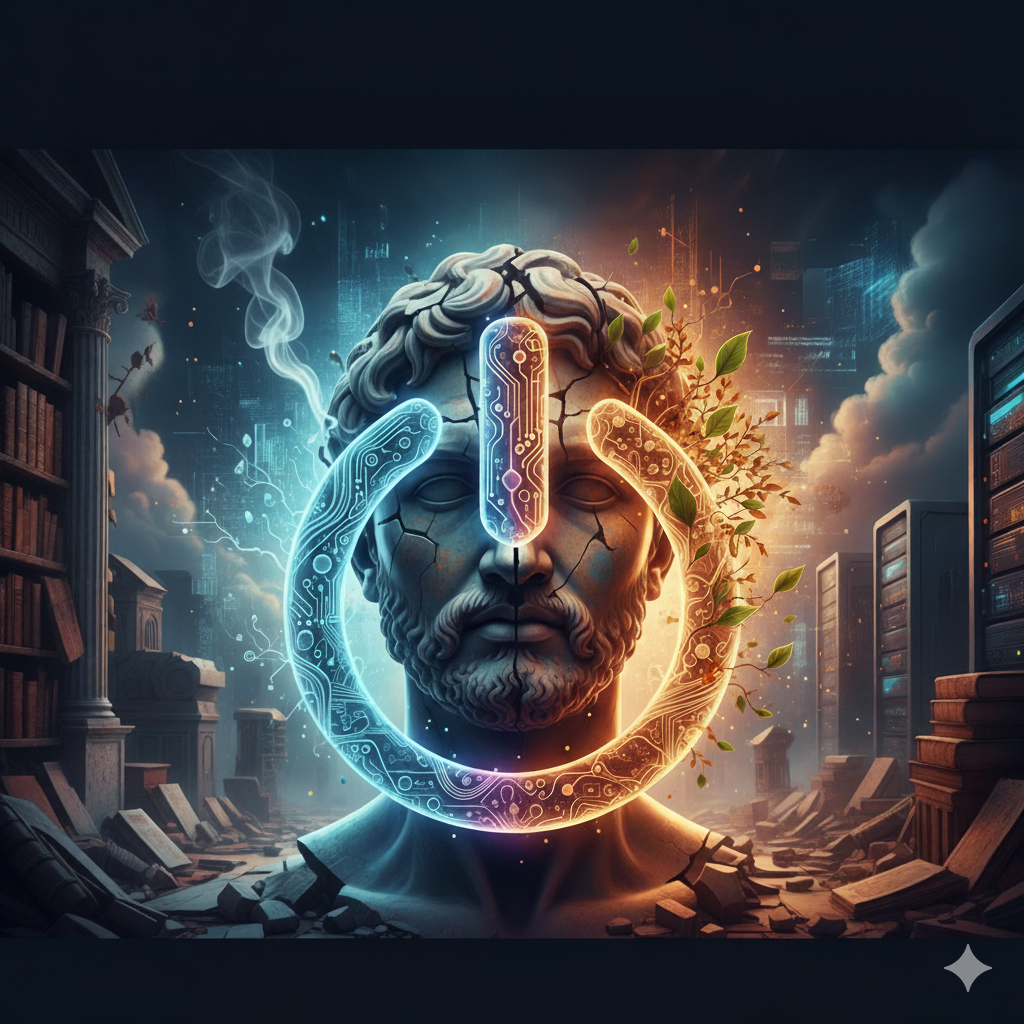
    The Philosophy of Restart: on the Art of Turning It Off and On Again

    Spread the love

    “Simplicity is the ultimate sophistication.” – Leonardo da Vinci

    In our increasingly complex world, we often search for sophisticated solutions to stubborn problems. Whether we’re contemplating our next move on a chessboard, lining up a putt on the 18th green, or staring at a frozen computer screen, we instinctively reach for complex strategies. But there’s a profound wisdom in the humble restart—the art of beginning again. Sometimes the most sophisticated response to complexity is the simplest one: turning it off and on again.

    The Chess Master’s Paradox: Complexity Born from Simple Rules

    Chess, often called the “game of kings,” presents us with a beautiful paradox. Its rules can be learned in minutes—pawns move forward, rooks move straight, bishops diagonal, and so forth. Yet from these simple foundations emerges a complexity so vast that even the most powerful computers struggle to master it completely.

    The grandmaster doesn’t win by calculating every possible variation (an impossible task), but by recognizing patterns, understanding principles, and making seemingly simple moves that carry profound strategic weight. As chess legend JosĂ© Capablanca once said, “I see only one move ahead, but it is always the correct one.”

    This mirrors the philosophy of restart in technology and life. The most elegant solutions don’t necessarily involve the most sophisticated algorithms or the most complex strategies. Sometimes, the most profound move is the simplest one: beginning again.

    // The simplest solution is often the best solution
    function fixComputer() {
        return restart();
    }
    

    The Knight’s Move: Sometimes the Indirect Path is the Direct One

    In chess, the knight moves in an L-shape—seemingly the most convoluted piece on the board. Yet this apparent complexity serves a simple purpose: it can jump over other pieces and reach squares that no other piece can access directly. Sometimes, the most elegant solution requires what appears to be an indirect approach.

    Much like how we solve computer problems. Your video won’t play? Don’t dive into codec configurations and driver compatibility matrices. Just restart the browser. Your Wi-Fi is acting up? Skip the network diagnostics. Restart the router. The knight’s wisdom: sometimes the most circuitous path is actually the straight line.

    Checkers: The Beauty of Democratic Simplicity

    If chess is the aristocrat of board games, then checkers is its egalitarian cousin. Every piece starts equal, moves the same way, and has the same potential for greatness. There are no queens, no knights with their fancy L-shaped moves—just simple, honest pieces moving diagonally forward until they reach the promised land of “kinghood.”

    Yet within this democratic simplicity lies profound strategic depth. A checkers master understands that power comes not from having superior pieces, but from superior positioning and timing. Every move matters because every piece matters.

    In the world of technology, this translates to the principle that you don’t need the most expensive, feature-laden solution to solve a problem. Sometimes the $5 cable works just as well as the $50 “premium” one. Sometimes the basic plan is all you need. Sometimes—and this might shock you—restarting your computer works better than purchasing a new graphics card.

    The King Me Moment: When Simple Things Become Powerful

    In checkers, when a humble piece reaches the far end of the board, it becomes a king—gaining the power to move backward as well as forward. This transformation isn’t gradual; it’s instantaneous and complete. One moment you’re a regular piece, the next you’re royalty.

    This mirrors how simple solutions can have profound effects. When you restart your computer, you’re not just clearing the RAM—you’re ascending to a temporary digital kinghood where all processes are fresh, all connections are clean, and for a brief, beautiful moment, everything works exactly as it was designed to.

    “Have you tried turning it off and on again? No seriously, have you? Because I’m not joking. That’s literally the solution to 90% of your problems.” — Unknown IT Support Technician

    Golf: The Zen of Doing Less to Achieve More

    Golf presents us with perhaps the purest expression of the restart philosophy. The objective couldn’t be clearer: get a small ball into a small hole using the fewest strokes possible. The tools are simple: clubs and a ball. The technique appears straightforward: hit the ball toward the hole.

    Yet golf humbles even the most accomplished athletes because it demands a paradoxical mindset: the harder you try, the worse you get. The secret to golf lies in controlled relaxation, in trusting the swing you’ve practiced, in understanding that sometimes a gentle 7-iron is more effective than a mighty driver.

    The Restart Swing: When Everything Goes Wrong, Go Back to Basics

    Every golfer knows the feeling: you’re having a terrible round, nothing is going right, and every shot seems to make things worse. The temptation is to try harder, swing faster, change your grip, adjust your stance, buy new clubs. But seasoned golfers know better. They step back, take a deep breath, and return to their most basic, fundamental swing.

    This is the golf equivalent of restarting your computer. When everything goes wrong with technology, we often try increasingly complex solutions: we update drivers, modify registry settings, install new software, consult online forums, and perform digital rain dances. But the golf philosophy suggests a different approach: stop, breathe, and return to the fundamentals.

    # The golf swing of IT support
    sudo reboot
    
    # Sometimes that's all you need
    # No complex commands required
    # No advanced troubleshooting
    # Just... start over
    

    The Hole-in-One Philosophy: Perfection Through Simplicity

    A hole-in-one is golf’s ultimate achievement—not because it requires the most skill (though it certainly requires some), but because it represents the perfect marriage of preparation, execution, and a little bit of luck. It’s one swing, perfectly executed, that achieves what might otherwise take multiple attempts.

    In technology, the “hole-in-one” is that moment when the simplest solution works perfectly the first time. Your internet is down, you restart the router, and suddenly everything works flawlessly. Your phone is frozen, you hold down the power button for ten seconds, and it springs back to life. It’s not glamorous, it’s not sophisticated, but it’s perfect.

    The Great Restart: Technology’s Universal Solvent

    There’s something almost mystical about the restart. In a world where technology grows increasingly complex, where smartphones have more computing power than the computers that sent humans to the moon, where artificial intelligence can write poetry and diagnose diseases, the humble restart remains our most reliable problem-solving tool.

    The Philosophy of the Fresh Start

    Every restart is a small death and rebirth. The accumulated digital detritus of crashed processes, memory leaks, and confused states gets swept away, leaving a clean slate. It’s the technological equivalent of meditation—a return to a state of digital enlightenment where everything is as it should be.

    Consider the poetry of the restart sequence:

    1. Shutdown: All processes cease, all connections close, all activity stops
    2. The Void: For a brief moment, complete digital silence
    3. Rebirth: The system awakens, fresh and clean, ready to begin again
    # The philosophy of restart in code
    def solve_problem():
        if problem_exists():
            restart()
            return "Have you tried turning it off and on again?"
        else:
            return "Problem solved!"
    
    # This function has approximately 90% success rate
    # Better than most enterprise software solutions
    

    The Restart Jokes: A Cultural Phenomenon

    The restart has become such a fundamental part of our technological experience that it’s spawned an entire genre of humor:

    • Classic IT Support: “Have you tried turning it off and on again?” (The battle cry of help desks worldwide)
    • The Relationship Restart: “Maybe we should try turning our relationship off and on again.”
    • The Life Restart: “I’m not having a midlife crisis, I’m just restarting my operating system.”
    • The Cooking Restart: “This recipe isn’t working. Let me restart the oven.” (This doesn’t actually work, but we’ve all thought about it)
    • The Pet Restart: “My cat is being weird. Have I tried turning it off and on again?” (Please don’t actually try this)

    The Deeper Truth Behind the Restart Joke

    But why is the restart joke so enduring and universally understood? Because it represents something profound about the human condition. We all wish we could restart when things go wrong—clear our mental cache, reload our emotional operating system, and begin fresh with all the bugs fixed and all the conflicts resolved.

    The restart is the technological manifestation of our deepest desire: the chance to begin again.

    Lessons from the Games: Applying Restart Wisdom to Life

    What can chess, checkers, and golf teach us about the art of beginning again and living with restart wisdom?

    From Chess: Pattern Recognition Over Calculation

    Chess masters don’t succeed by calculating every possibility—they succeed by recognizing patterns and trusting their intuition built through experience. In life, this means:

    • Trust your instincts when they’re based on experience
    • Look for patterns in problems rather than trying to solve each instance individually
    • Sometimes the obvious move is obvious for a good reason

    From Checkers: Democratic Excellence

    Checkers reminds us that you don’t need special advantages to succeed—you need good positioning and timing. In life, this translates to:

    • Focus on your positioning (skills, relationships, opportunities) rather than lamenting what you lack
    • Timing matters more than raw power
    • Every move matters, no matter how small

    From Golf: The Power of Letting Go

    Golf teaches us that trying harder often produces worse results. The application to life:

    • Sometimes the solution is to stop trying to solve the problem and just restart
    • Perfection comes through practice of fundamentals, not through exotic techniques
    • The target rarely moves; usually, the problem is with our approach

    The Restart Metaphor: Beyond Technology

    The restart concept extends far beyond technology. Consider these life “restarts”:

    The Career Restart

    Sometimes the best career move isn’t climbing the next rung on the ladder—it’s getting off the ladder entirely and finding a new one. The traditional advice says to persist, to work harder, to network more effectively. But sometimes the most elegant solution is to simply restart your career entirely.

    The Relationship Restart

    When relationships become cluttered with old arguments, accumulated resentments, and complex emotional baggage, sometimes the answer isn’t couples therapy or communication workshops. Sometimes it’s a simple restart: acknowledgment that you’re both different people than when you started, and a fresh beginning with clear expectations.

    The Daily Restart

    Every morning is a restart. Every meditation session is a restart. Every moment you choose to let go of what just happened and focus on what’s happening now is a restart.

    “Confine yourself to the present.” — Marcus Aurelius

    The Complexity Trap: When Simple Becomes Complicated

    One of the great ironies of our time is how we’ve managed to make simple things complicated. Consider:

    The Smart Home Paradox

    We’ve created “smart” homes where it takes three different apps, two voice commands, and a PhD in network engineering to turn on a light bulb. Sometimes the old-fashioned wall switch was the superior technology—one action, immediate result, 100% reliability.

    The Communication Complexity

    We have more ways to communicate than ever before—email, text, Slack, Discord, WhatsApp, Teams, Zoom, FaceTime, carrier pigeons (okay, maybe not the last one). Yet somehow it’s become harder to actually communicate. Sometimes the most effective message is still the simplest: a phone call that starts with “Hi, how are you?”

    The Entertainment Paradox

    We have access to more entertainment than any generation in human history, yet we spend most of our time scrolling through options, unable to decide what to watch. The restart solution? Pick something randomly and watch it. The paradox of choice dissolves when you make choosing itself simple.

    The Minimalist Movement: Restart as Liberation

    The growing minimalist movement represents a cultural restart—a recognition that accumulation of stuff doesn’t lead to accumulation of happiness. Minimalists ask the radical question: “What if having less actually means having more?”

    This connects directly to our restart philosophy. Just as restarting a computer clears away accumulated digital clutter, minimalism clears away accumulated physical and mental clutter. It’s about periodically restarting your relationship with possessions.

    Digital Minimalism

    Cal Newport’s concept of “digital minimalism” is essentially the restart philosophy applied to our relationship with technology. Instead of trying to manage the overwhelming complexity of notifications, apps, and digital distractions, digital minimalists regularly “restart” their digital lives by:

    • Periodically deleting apps and starting fresh
    • Taking regular breaks from social media (digital restarts)
    • Choosing simpler tools over feature-rich alternatives
    // Digital minimalism in practice
    function digitalDetox() {
        socialmedia.uninstall();
        notifications.disable();
        phone.putInDrawer();
        return mentalClarity.activate();
    }
    
    // The most powerful technology is often no technology
    

    The Science of Restart: Why Beginning Again Works

    There’s actual science behind why the restart is so effective, both in technology and in life:

    Cognitive Load Theory

    Our brains, like computers, have limited processing capacity. When we accumulate too many “processes” running in the background—worries, distractions, unfinished tasks—our performance degrades. A mental restart (meditation, sleep, vacation) clears this cognitive cache.

    The Zeigarnik Effect

    Psychologist Bluma Zeigarnik discovered that we remember interrupted tasks better than completed ones. This means unfinished business creates mental background processes that consume cognitive resources. Restarting allows us to either complete these tasks or consciously choose to let them go.

    Neuroplasticity and Fresh Starts

    Neuroscience shows that our brains are constantly rewiring themselves. Every restart—whether it’s a new day, a new relationship, or a new project—is an opportunity for neural rewiring. The fresh start effect isn’t just psychological; it’s biological.

    The Art of Knowing When to Restart

    The wisdom isn’t just in knowing how to restart—it’s in knowing when to restart. Consider these scenarios:

    When to Restart Your Computer

    • Before the problem becomes critical
    • When you notice performance degradation
    • After installing new software
    • When your spouse asks if you’ve tried turning it off and on again (this is a universal signal)

    When to Restart Your Approach to a Problem

    • When you’re trying the same failed solutions repeatedly
    • When the solution has become more complex than the original problem
    • When you find yourself googling “advanced troubleshooting techniques” for something that should be simple

    When to Restart Your Life Direction

    • When you’re moving fast in the wrong direction
    • When your current path requires you to become someone you don’t want to be
    • When success in your current trajectory feels like failure

    “In pursuit of knowledge, every day something is added. In pursuit of wisdom, every day something is dropped.” — Lao Tzu

    The Economics of Restart

    There’s an economic principle hidden in the restart philosophy: the cost of overthinking often exceeds the cost of restarting. Consider:

    Time Economics

    • Troubleshooting time: 2 hours researching obscure solutions
    • Restart time: 2 minutes
    • Success rate: Approximately equal

    Mental Economics

    • Stress of complex solution: High cognitive load, potential for new problems
    • Stress of restart: Minimal, familiar process

    Opportunity Economics

    • Time spent on complex solution: Could have been spent on productive work
    • Time spent on restart: Essentially zero opportunity cost

    Cultural Wisdom: The Universal Art of Beginning Again

    The philosophy of restart isn’t new—the wisdom of beginning again appears across cultures and throughout history:

    Eastern Philosophy

    • Buddhism: The Middle Way avoids extremes
    • Taoism: Wu wei—effortless action
    • Zen: Direct pointing to the mind, bypassing complexity

    Western Philosophy

    • Stoicism: Focus on what you can control
    • Minimalism: Less is more
    • Pragmatism: What works is what matters

    Indigenous Wisdom

    • Native American: Take only what you need
    • Aboriginal: Follow the songlines (simple, direct paths)
    • African: Ubuntu—I am because we are (simple human connection)

    The Paradox of Teaching Restart

    Here’s the irony: I’ve written several thousand words to explain the philosophy of restart. This itself seems to violate the principle I’m advocating. The simplest explanation of restart wisdom would be:

    When in doubt, restart.
    

    But sometimes we need the complex explanation to understand the simple truth. Sometimes we need to think deeply about thinking less. Sometimes we need to write extensively about saying less.

    This is the teacher’s paradox: using complexity to point toward simplicity, using many words to advocate for fewer words, using sophisticated reasoning to arrive at obvious conclusions.

    Practical Applications: The Restart Toolkit

    How can you apply restart philosophy immediately?

    Daily Restart Practices

    1. Morning Restart: Begin each day as if yesterday’s problems don’t exist
    2. Midday Reset: Take a brief pause to clear mental cache
    3. Evening Shutdown: Consciously end the day and release its concerns

    Problem-Solving Restart Protocol

    1. Identify the problem
    2. Ask: “What’s the simplest possible solution?”
    3. Try the simple solution first
    4. If it doesn’t work, restart the problem-solving process
    5. Resist the urge to immediately escalate complexity

    Relationship Restart Methods

    1. Daily: Assume positive intent
    2. Weekly: Have a fresh conversation about a recurring issue
    3. Monthly: Restart expectations and agreements
    4. Annually: Restart the relationship itself—who are you both now?

    Career Restart Indicators

    • You’re solving problems that shouldn’t exist
    • Your job requires you to make simple things complicated
    • You spend more time managing tools than using them
    • You can’t explain what you do in simple terms

    The Future of Restart

    As technology becomes more complex, the value of restart wisdom increases exponentially. We’re approaching what some call “peak complexity”—the point where additional features subtract value rather than add it.

    The future belongs to those who can:

    • Cut through complexity to find simple solutions
    • Restart gracefully when current approaches aren’t working
    • Recognize when good enough is perfect
    • Choose simple tools over complicated ones

    AI and the Return to Restart Simplicity

    Ironically, artificial intelligence—one of the most complex technologies ever created—is making interaction with technology simpler. Instead of learning complex interfaces, we’re returning to the most natural interface of all: conversation.

    “Turn off the lights” is simpler than navigating through three menus and two sub-screens. AI is the restart that takes us back to intuitive interaction.

    Conclusion: The Profound Wisdom of Starting Over

    In chess, the most elegant games often involve simple, classical moves executed with perfect timing. In checkers, victory comes to those who understand that every piece matters and that simple, consistent progress trumps dramatic gestures. In golf, the perfect swing feels effortless because it embodies years of practice distilled into a moment of pure simplicity.

    And in technology—in life—the restart remains our most reliable solution because it embodies the deepest wisdom: sometimes the most sophisticated response to complexity is to begin again.

    The philosophy of restart isn’t about avoiding complexity or dumbing things down. It’s about recognizing when to persist and when to start fresh. It’s about having the wisdom to know that sometimes progress comes through regression—taking a step back to move forward more effectively.

    Most importantly, it’s about remembering that in a world that profits from your confusion, your ability to find simple solutions is a form of rebellion. Every time you solve a complex problem with a simple restart, you’re asserting that clarity is possible, that not everything needs to be complicated, and that sometimes—just sometimes—the obvious answer is obvious because it’s correct.

    “I would not give a fig for the simplicity that lies on this side of complexity, but I would give my life for the simplicity that lies on the far side of complexity.” – Oliver Wendell Holmes

    So the next time you’re facing a complicated problem—whether it’s a frozen computer, a difficult relationship, or a life that feels too complex to manage—remember the wisdom of the restart. Sometimes the most profound solution is also the simplest one:

    Turn it off. Count to ten. Turn it back on.

    And trust that sometimes, beginning again is the most sophisticated thing you can do.


    Have you tried restarting your perspective? Because that’s literally the solution to 90% of life’s problems.

    # The ultimate life command
    sudo reboot --life
    # Warning: This command may require courage to execute
    # Results may vary, but satisfaction guaranteed
    

    This article is part of the Restart Project—an exploration of how elegant solutions emerge from simple principles. To see this philosophy in action, visit our 🌐 collection of restart commands across 50+ programming languages, where the most powerful operation is often the simplest one: turning it off and on again.