
Author: ekelola

  • Manners, Love and Lust: Where Fire Learns to Bow

    Manners, Love and Lust: Where Fire Learns to Bow

    Spread the love

    Manners are the quiet rituals through which
    love becomes visible.

    They are the pauses before speech,
    the softened tone, the remembered name.
    They say: I see you. I honour your space.

    Love, in its rawest form, can be wild—
    impulsive, consuming, divine.
    Manners refine it without dulling its warmth;
    they give love rhythm, dignity, and grace.

    Without love, manners are performance.
    Without manners, love can wound even as it tries to embrace.

    Together, they teach us that affection is not only felt—
    it is practised.

    Manners are love’s structure.
    Love is manners’ soul.

    Where Lust Comes In

    Love, manners, and lust form a workable triad:

    • Lust — energy and drive (the heat, the propulsion).
    • Love — orientation and commitment (the why, the direction).
    • Manners — container and regulator (the how, the form).

    1. Before Love (Ignition)

    Lust can be the first spark of attention.
    Here, manners keep the spark from becoming a brushfire:
    curiosity without entitlement, interest without pressure, invitation not insistence.

    2. Within Love (Vitality)

    In enduring relationships, lust is the vitality that keeps tenderness alive.
    Manners turn raw appetite into intimacy—through consent, timing, and attunement—
    so desire becomes for the other, not merely at the other.

    3. Outside Love (Temptation / Testing)

    Lust also appears when it shouldn’t.
    Manners create guardrails—honesty, restraint, and clear boundaries—
    that protect promises and people from momentary impulses.

    What Manners Do to Lust

    • Differentiate: “I feel desire” ≠ “I’m owed access.”
    • Pace: Slow enough to notice the person, not just the sensation.
    • Translate: Convert urge into communicable care—asking, listening, checking in.
    • Protect: Safeguard consent, dignity, and the future from the intensity of the present.

    Failure Modes

    • Polite Lust: Manners as a mask for pressure—gentle tone, coercive intent.
    • Lawless Love: “Because I love you, anything goes.” Love used to excuse harm.
    • Bloodless Manners: Perfect etiquette with no heart. Performance over presence.

    Practical Diagnostics

    Ask yourself:

    • Would I accept a clear no without resentment?
    • Does my desire make me more gentle, honest, and patient—or less?
    • Am I drawn to this person in their wholeness, or would any body do?
    • Do I care about their tomorrow, not just my now?

    If the answers lean toward care, lust is being shaped into love.
    If not, lust is using manners as camouflage.

    A Chess Analogy

    • Lust is the initiative—tempo and attacking chances.
    • Manners are positional principles—don’t overextend, respect boundaries, develop with purpose.
    • Love is the long game—the endgame you’re playing toward.

    Without principles, initiative blunders.
    Without initiative, the position dies.
    Without a plan, both are wasted.

    The Lesson of Integration

    Lust is not the enemy of virtue—only its untrained limb.
    When repressed, it festers; when indulged, it consumes.
    Integration means letting it belong without letting it rule.

    To integrate lust is to recognise it as life-force
    a current that can be harnessed toward creation, intimacy, art, prayer, or play.
    It asks not for suppression, but stewardship:
    to feel its flame fully while remaining aware of its direction.

    “Obsession is desire stripped of manners—fire demanding to be worshipped.”

    When the body’s fire serves the heart’s clarity,
    lust becomes not a fall from grace,
    but a participation in it.

    Closing Reflection

    Lust provides heat.
    Manners provide shape.
    Love provides meaning.

    When all three cooperate, desire becomes devotion—
    energy that warms without burning,
    and a heart that acts with both fire and form.

  • The Two Stones: Alchemy, Grief, and the Meaning of Transformation

    The Two Stones: Alchemy, Grief, and the Meaning of Transformation

    Spread the love

    Both the Philosopher’s Stone and the Resurrection Stone from the Harry Potter universe carry far deeper meanings than their magical appearances suggest.
    Each stone is an allegory — one for transcendence, the other for acceptance — together forming a mirror to the human soul’s eternal struggle between mastery and surrender.

    🜍 The Philosopher’s Stone — The Alchemy of Transformation

    In alchemy, the Philosopher’s Stone was believed to turn base metals into gold and grant immortality.
    But beneath the myth lies a spiritual truth: the transmutation of the self.

    • Base metal → Gold: The transformation of the ordinary human soul into an awakened, purified consciousness.
      The lead of ego, ignorance, and fear becomes the gold of clarity, compassion, and wisdom.
    • Elixir of Life: The inner vitality that arises when one discovers the deathless essence within — not literal immortality, but the awareness of eternity through presence.

    To seek the Philosopher’s Stone is not to chase endless life, but to awaken to the life that never ends.
    It is the pursuit of inner alchemy — the refining of the self through suffering, love, and awareness until all impurities burn away.

    “The gold was never in the crucible, but in the heart that dared to endure the fire.”

    ⚰️ The Resurrection Stone — The Longing for Reunion

    The Resurrection Stone, one of the Deathly Hallows, offers the power to bring back the dead.
    Yet the souls it calls forth are cold reflections — echoes of memory, not life itself.

    This is no gift of resurrection, but a lesson in attachment.

    The Resurrection Stone symbolizes:

    • The refusal to let go, the desire to reverse loss rather than accept it.
    • The temptation to live in the past, to clutch what time has already transformed.
    • The grief that binds, when love becomes possession.

    When Harry uses the stone before his own death, he doesn’t wield it to deny mortality — he uses it to face mortality.
    It becomes a companion in courage, a bridge between the living and the loved, reminding him that love outlasts form.

    The Resurrection Stone thus speaks to amor fati — the love of fate.
    It teaches that acceptance, not defiance, is the true resurrection.

    🜂 In Synthesis — The Two Halves of the Quest

    The two stones together embody the twin movements of spiritual maturity:

    Stone Symbolizes Deeper Allegory
    Philosopher’s Stone Transformation The quest to transcend the limits of the self and become whole.
    Resurrection Stone Reconciliation The quest to make peace with loss, death, and the impermanence of all things.

    One says, “Become eternal within yourself.”
    The other whispers, “Let go — eternity is already within you.”

    ✨ Closing Reflection

    To hold both stones in the mind is to understand the paradox of human existence:
    we strive to transcend life even as we are called to love it, fleeting and fragile as it is.

    The alchemist and the mourner are one and the same —
    both seeking a way to touch eternity,
    one through transformation,
    the other through surrender.

    The first stone turns life into gold.
    The second teaches that even ashes can shine.
  • The Weight of Blame: Between the King and the Divine

    The Weight of Blame: Between the King and the Divine

    Spread the love

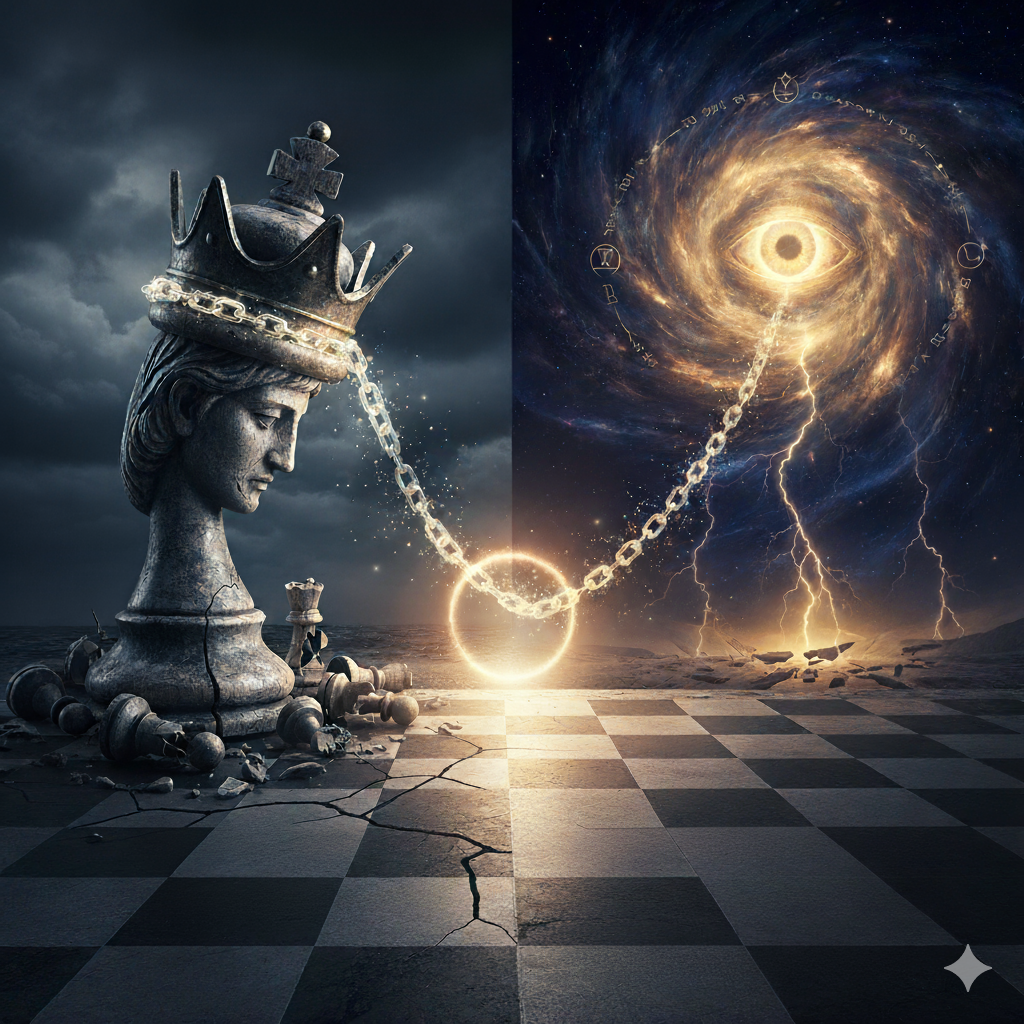
    Blame” is a deceptively small word for something that shapes entire lives.

    A subtle crown — heavy, invisible, and often worn without choice.

    At its core, blame is the act of assigning responsibility for pain — a way to make sense of suffering by locating its source.
    But like fire, it can either illuminate or destroy.

    ♔ The King’s Burden

    In chess, the king moves one square at a time — slow, deliberate, measured.
    His very presence commands the board, yet his power is paradoxically fragile.

    Every mistake by his army — every lost pawn, every fallen rook — reflects upon him.
    When the king is cornered, it is he who bears the blame,
    even if he never lifted a sword.

    This is the nature of leadership, and of consciousness itself:
    to be awake is to be accountable.
    To be sovereign is to face the consequences of the realm’s chaos.

    ⚖️ The Double Edge of Blame

    Used wisely, blame becomes discernment
    the capacity to see cause and effect clearly,
    to learn from mistakes, to protect boundaries.

    But misused, it turns into projection
    a refusal to face one’s own shadow,
    an evasion of growth.

    It clouds perception,
    turns allies into threats,
    and converts lessons into wounds.

    🌩️ The Wrath of the Divine

    In the ancient imagination, the wrath of God was not mere anger —
    it was a mirror of divine justice,
    a reflection of imbalance restored through force.

    Wrath was not the tantrum of a deity,
    but the echo of a world out of harmony.
    It was blame cosmicized
    the universe setting itself right again.

    So perhaps human blame is a smaller current of that same energy —
    a fragile echo of the cosmic attempt to impose order on confusion.

    Yet to live wisely, one must learn when to release blame
    and replace it with reverence:
    to see not punishment, but pattern;
    not wrath, but awakening.

    ♜ The Lesson of the King

    The king, if he survives, does not blame his pawns.
    He simply learns to see the whole board more clearly.

    And maybe that is what the divine does too —
    not to condemn,
    but to remind.

    Blame says: “You hurt me.”
    Responsibility says: “Here’s what I can do now.”

    Between those two statements lies the threshold of maturity
    the quiet moment where resentment turns into awareness,
    and awareness into freedom.

  • Soccer and Philosophy: Inertia of the Human Spirit and The Geometry of Being

    Soccer and Philosophy: Inertia of the Human Spirit and The Geometry of Being

    Spread the love

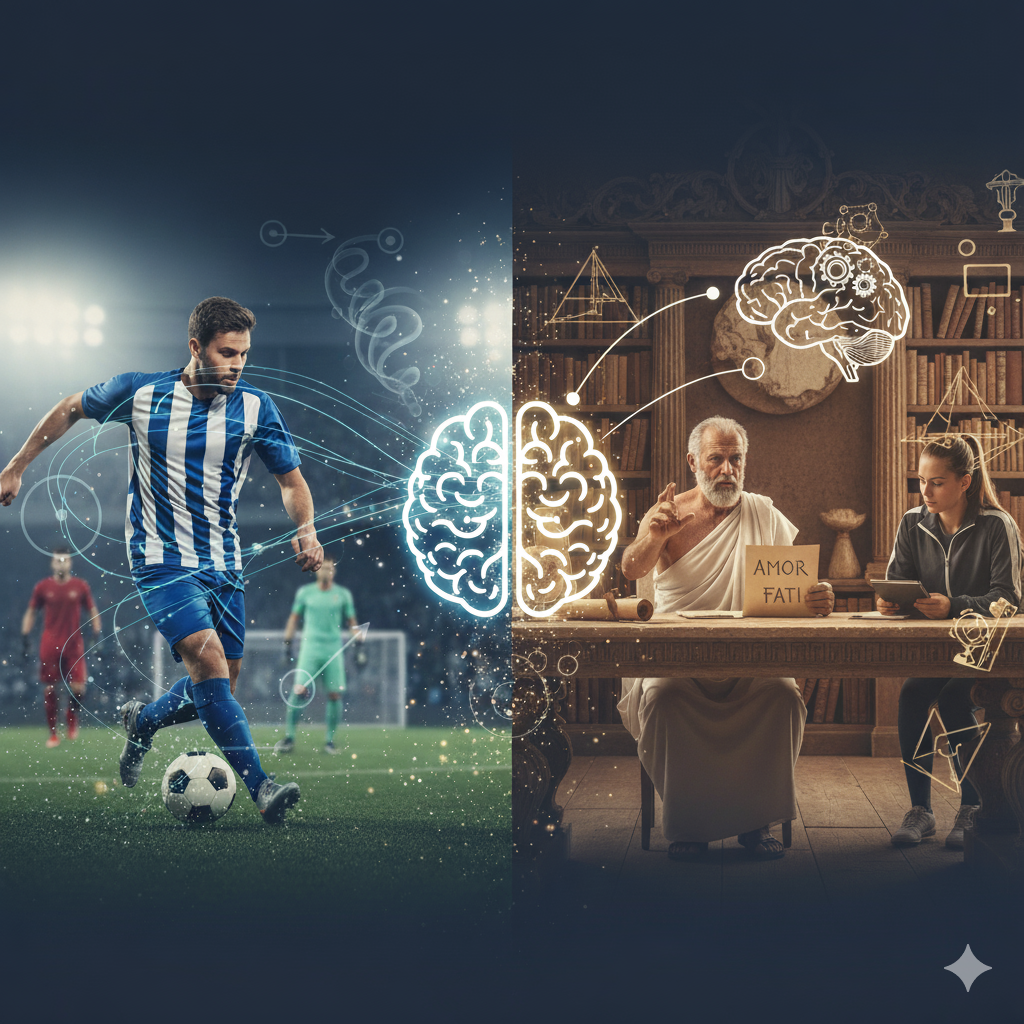
    Soccer is not just a physical sport — it’s a mental and even philosophical game.
    On the field, twenty-two players move with strategy and skill, yet an invisible battle of minds unfolds with every pass and shot. The intersection of momentum, mindset, and fate shapes each outcome as much as any tactic, revealing soccer as a test of both body and spirit.

    Momentum and the Law of Inertia

    A soccer ball obeys the laws of physics: it stays at rest until a kick sets it in motion, and once moving it continues until something stops it.
    Teams and players carry the same energy. Confidence can snowball during a match — each successful pass or goal fueling the next — just as doubt can settle in and linger until some force (a pep talk, a change in rhythm, a flash of brilliance) breaks the cycle.

    Sports psychologists often describe momentum as a psycho-emotional force — the intangible flow and feel of a game that can swing with a single moment.
    Because momentum can shift in an instant, elite players train their focus and emotional control to ride its waves without losing balance. The mental game is to stay composed when everything flows your way and when nothing does.

    The mind acts as both engine and rudder — fueling effort, but also steering through the unpredictable currents of fortune that every match brings.

    Amor Fati — Embracing Fate on the Field

    In soccer as in life, not everything can be controlled.
    A perfectly struck shot may strike the post. A referee’s call may feel unjust. Rain may turn the pitch into a test of balance and will.

    Amor fati, the Stoic phrase meaning “love of fate,” invites the player to embrace whatever unfolds — not merely to accept it, but to welcome it.
    Epictetus wrote that while we cannot choose our circumstances, we can always choose our response.

    A player who practices amor fati sees every deflection, mistake, or moment of chaos as part of the larger design — the story of the match that must unfold as it does.
    Resistance leads to frustration; surrender leads to flow.

    A team that “loves its fate” finds meaning even in defeat, using it to sharpen their resilience.
    To greet each outcome with calm humility and courage is to master the one thing truly within our control — our state of mind.

    Setbacks become teachers; adversity becomes the path forward.
    Like the ball that keeps rolling, we move again, guided by grace and gravity.

    Mind, Body, and the Beauty of the Game

    Ultimately, soccer’s mental game is about harmonizing mind and body in motion.
    When a player is fully present — physically pushing their limits while mentally embracing the moment — something transcendent occurs.
    This is the flow state: where thought and action merge, and the self dissolves into pure play.

    The team moves as one body; intuition replaces instruction.
    In this dance between control and surrender, soccer becomes not just sport but meditation — a lesson in how to live.

    Modern coaches understand this balance.
    They train players not just in tactics, but in mindfulness, visualization, and self-regulation — teaching them to think clearly, breathe deeply, and adapt gracefully.

    The goal is not to conquer fate, but to collaborate with it.
    Victory is fleeting; awareness endures.

    In the end, soccer’s beauty lies in its paradox — motion born of stillness, freedom born of discipline.
    The ball rolls, time passes, and in every touch we glimpse the truth: to move well, we must first accept where we are.


  • Golf and Psychology: The Mental Game

    Golf and Psychology: The Mental Game

    Spread the love

    Golf is not a game of power — it’s a game of precision, rhythm, and restraint. Unlike fast-paced sports defined by bursts of adrenaline, golf unfolds in silence. Every stroke, every breath, every decision is a reflection of the player’s inner state. The true contest happens not between golfer and opponent, but between golfer and mind.

    Golf is often described as the most psychological of all sports — a quiet duel between mind, body, and landscape. Every swing is a test of composure, and every hole, a meditation on imperfection. To play well is to think clearly, feel deeply, and remain unshaken by both triumph and error.

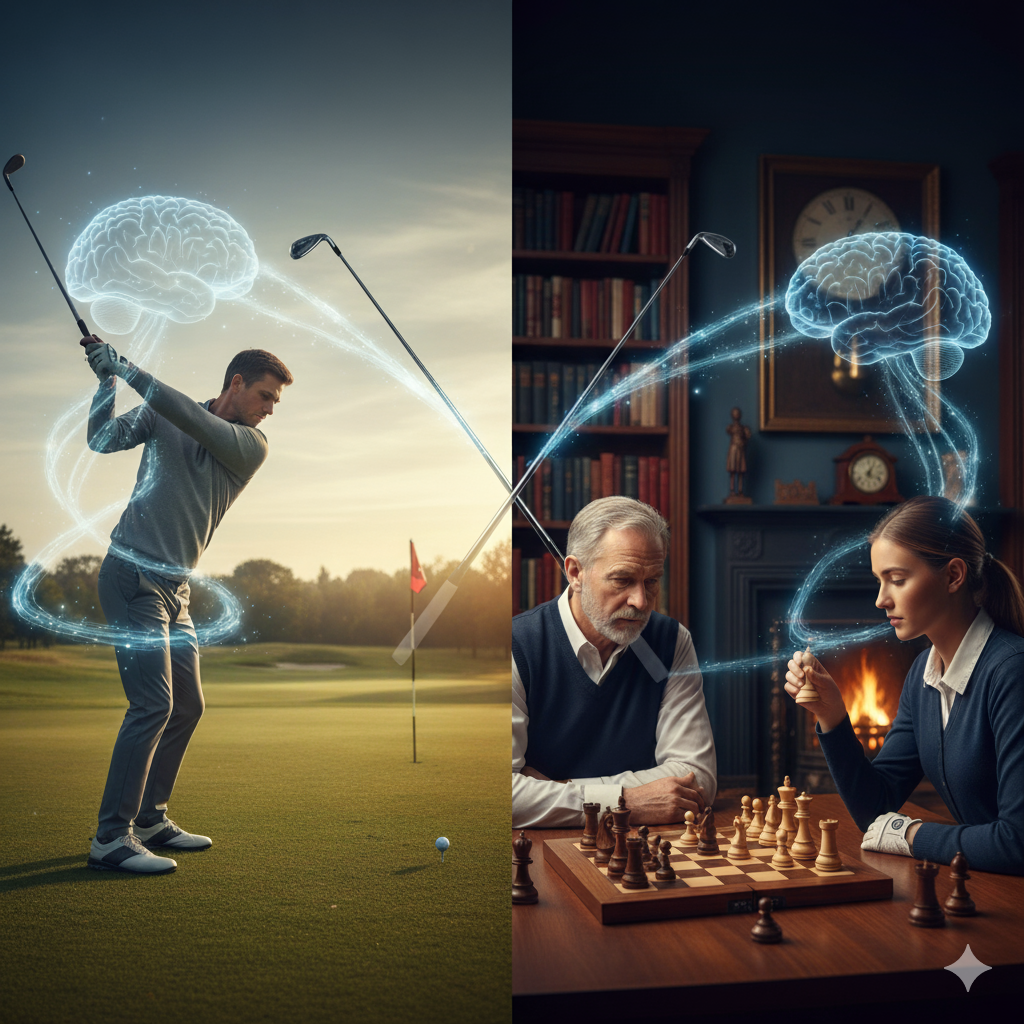
    Yet beneath its calm surface, golf shares surprising similarities with another mental battleground: chess.

    The Parallels Between Golf and Chess

    At first glance, golf and chess appear worlds apart — one unfolds across rolling greens under the sun, the other across sixty-four squares of silent tension. But both demand the same rare virtues: patience, foresight, and emotional discipline.

    A chess player visualizes the board several moves ahead. A golfer visualizes the course several holes ahead. Both must hold a plan loosely enough to adapt when reality intervenes. The greatest skill lies not just in calculation, but in the ability to recover mentally after a mistake.

    Where the chess player resists impulsive attacks, the golfer resists the temptation of the risky shot. Each game teaches the same internal law: control your impatience, or impatience will control you.

    The Paradox of Stillness

    To play golf well is to master stillness in motion. The rhythm of the swing — steady, deliberate, calm — mirrors the rhythm of thought. When the mind rushes ahead, the body follows in error. But when attention returns to the moment, the club meets the ball with effortless grace.
    In this sense, golf is an act of meditation disguised as sport. It teaches that control is not achieved by force, but by surrender — the quiet alignment of intention and execution.

    Patience as the Ultimate Virtue

    Patience — perhaps the rarest of human virtues — is the quiet pulse behind both mastery and meaning. In golf, it takes the form of slowness with intent: the measured breath before the swing, the still mind amid wind and distance.

    The golfer’s challenge is to remain centered between two extremes: hesitation and haste. Like in chess, where a single rash move can undo hours of calculation, golf punishes emotional lapses disguised as confidence.

    To play patiently is not to play slowly — it is to move with awareness, to act when readiness, not restlessness, dictates the moment.

    The Mirror Within

    Golf, like chess, reflects the inner landscape of the player. The course and the board reveal who you are when things do not go as planned. Do you tighten, or do you trust? Do you chase perfection, or do you seek understanding?

    In both games, improvement is less about technique and more about temperament. Progress is psychological before it is mechanical.

    Patience, then, is not merely a strategy — it is the spiritual core of performance. It aligns thought, emotion, and motion into a single, deliberate act.

    Conclusion

    Golf and chess remind us that mastery is an inward journey disguised as an external one. The mind must be trained before the hands, and peace must precede precision.

    In the end, golf’s true scorecard isn’t kept in strokes, but in moments of stillness between them — where awareness replaces anxiety, and patience becomes both teacher and triumph.

  • How to Select the Right Tool: Defining Boundaries vs. Attacking the Objective

    How to Select the Right Tool: Defining Boundaries vs. Attacking the Objective

    Spread the love

    In a world overflowing with options, choosing the right tool—whether software, framework, or even a physical device—can feel overwhelming. The decision often lies between two approaches:

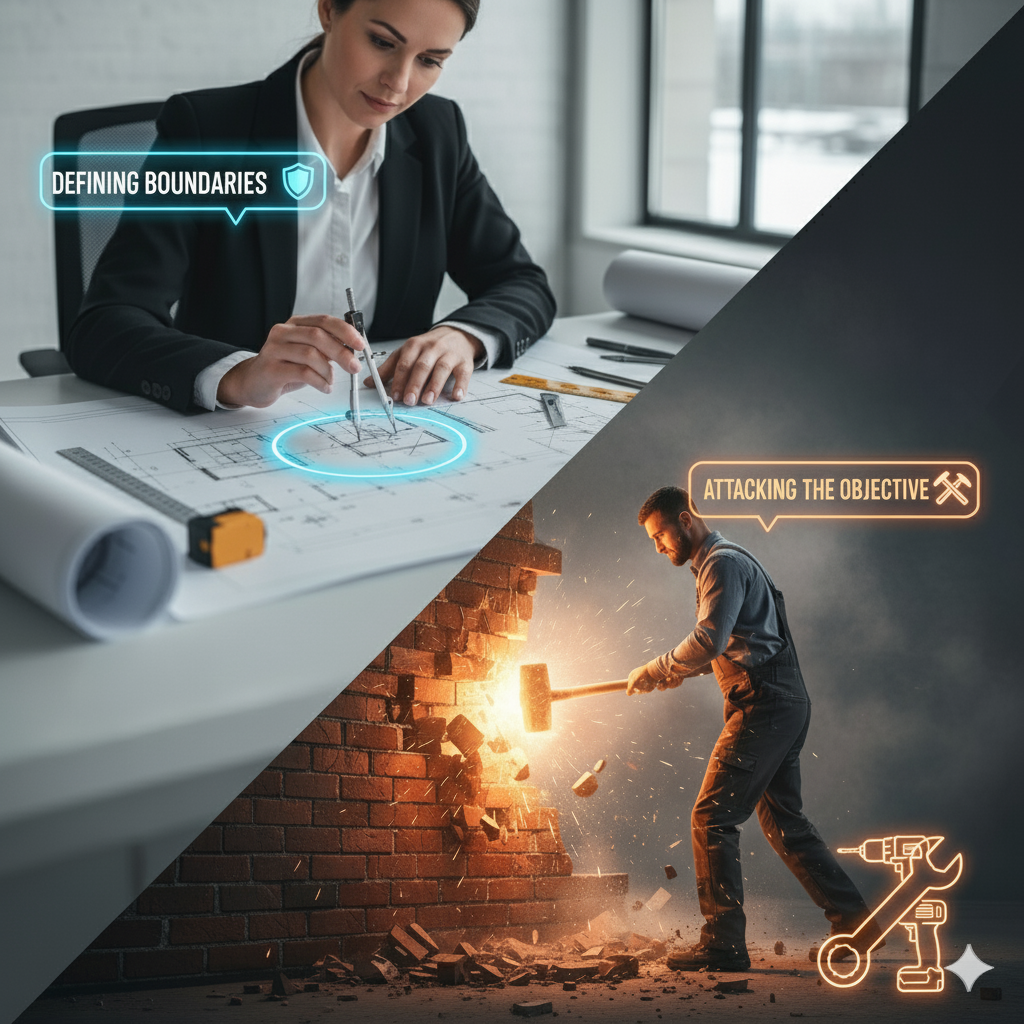
    • Defining boundaries: setting the limits of what you will and will not accept.
    • Attacking the objective: focusing directly on the outcomes you want to achieve.

    Understanding how these approaches interact gives you a framework for making better choices.

    Defining Boundaries

    Defining boundaries means clarifying constraints before diving into options. Think of it as your “non-negotiables.”

    Questions to ask:

    • Cost: What is the budget ceiling? Are there licensing, subscription, or scaling fees?
    • Capabilities: What must the tool absolutely do? Where are you willing to compromise?
    • Learning Curve: How long before you or your team can effectively use it?
    • Ecosystem: Does it integrate well with the tools and systems you already rely on?
    • Time Frame: Does it fit the project deadlines? Is it sustainable for long-term use?

    Boundaries prevent shiny-object syndrome—they filter out tools that look attractive but won’t serve your reality.

    Attacking the Objective

    While boundaries eliminate distractions, attacking the objective pushes you toward the end goal. Here the focus is less on limitations and more on performance.

    Key steps include:

    • Documenting Your Decision: Capture why you’re choosing a tool so future you (or your team) understands the logic.
    • Point of Control: Who owns the tool? Is it managed internally or outsourced? Does it centralize control or distribute it?
    • Mix and Match: Accept that no single tool is perfect. Sometimes combining specialized tools creates a stronger, more tailored solution.
    • Role Specificity: The more tools in your stack, the more special the ownership of the solution becomes. This can give rise to fragility—where the system cannot function without the original designer or architect of the solution.

    This approach ensures you don’t just choose a tool that fits constraints, but one that actively drives success.

    No Tool Is Perfect

    One of the most important lessons: no tool is perfect. Every tool has trade-offs.

    • Some offer speed but sacrifice flexibility.
    • Others are cheap but lack scalability.
    • A few might cover everything but overwhelm users with complexity.

    The key is to recognize that tools are levers, not magic. What matters most is how you combine them and align them with your goals.

    Balancing Boundaries and Objectives

    The best decisions emerge when boundaries and objectives meet:

    • Boundaries ensure sustainability and prevent costly mistakes.
    • Objectives ensure momentum and measurable progress.

    By pairing the two, you build a toolset that is practical, purposeful, and adaptable.

    Closing Thoughts

    Selecting the right tool is less about finding a “perfect fit” and more about aligning with context. Define your boundaries to avoid chaos, but don’t lose sight of the objective you’re trying to achieve.

    When in doubt, remember:

    • Start with what matters most.
    • Document your reasoning.
    • Accept imperfection.
    • Build a toolkit, not a single crutch.

    Tools don’t define success—you do. The right tool simply amplifies your intent.