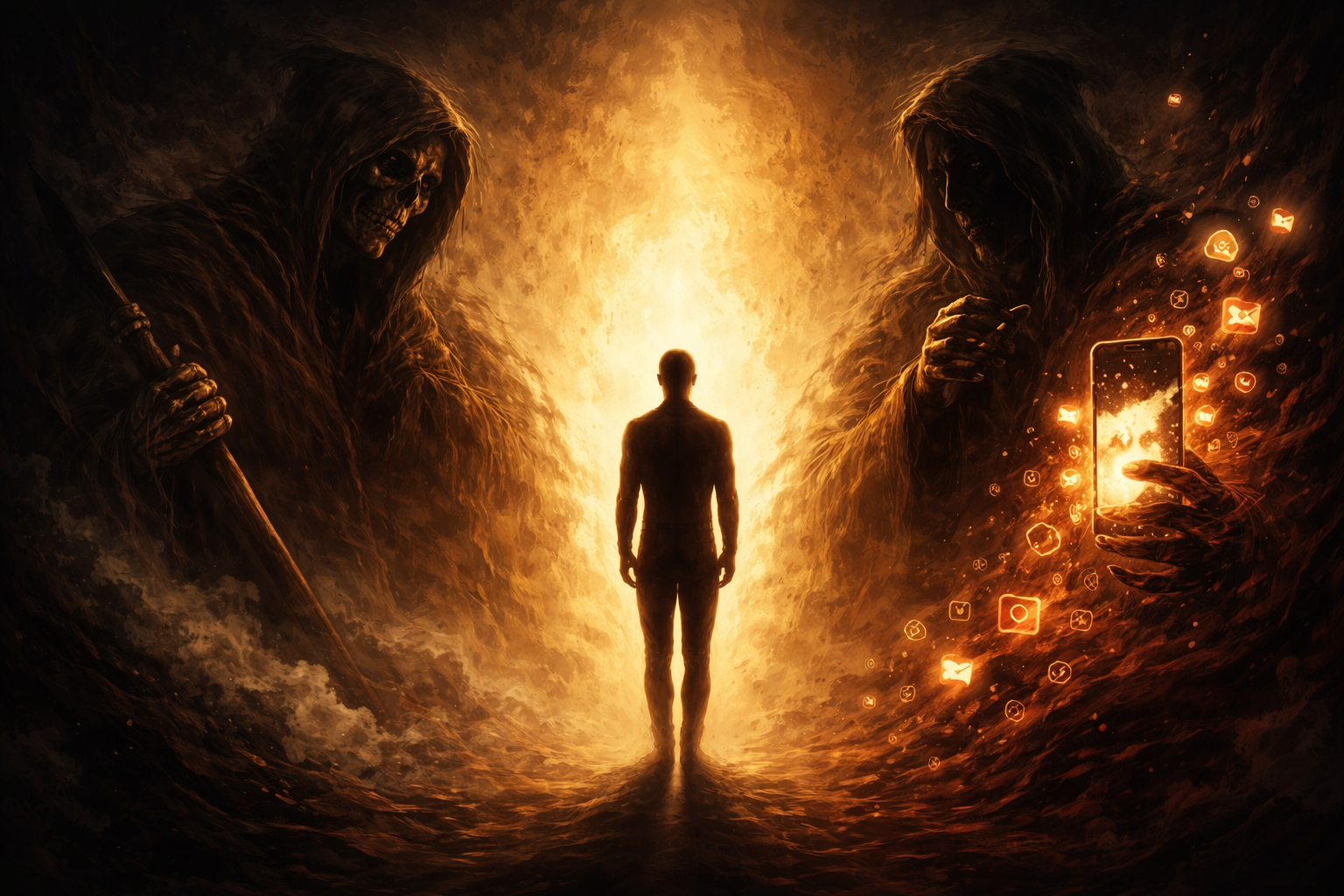
Prompt: Why does the fear of shame – and now the fear of missing out – sometimes eclipse the fear of death?
The Trinity of Terror
Shame. FOMO. Death.
There are many fears that govern human behaviour.
But beneath them, three stand apart – not as emotions, but as systems of survival:
- The fear of death
- The fear of shame
- The fear of missing out
Each corresponds to a different layer of existence:
- Death threatens the body
- Shame threatens the identity
- FOMO threatens the future
And in the modern world, it is no longer obvious which of these is most powerful.
Because to be human is not merely to stay alive.
It is to belong, and increasingly, to keep up.
🧠 1. The Psychological View: Survival, Belonging, and Obsolescence
From an evolutionary standpoint, survival was never an individual project.
To be cast out from the group was to lose access to:
- protection
- resources
- reproduction
Which meant one thing:
Isolation = Death
Shame – The Threat of Expulsion
Shame evolved as a regulatory mechanism.
It signals:
- “You have violated the group”
- “You are at risk of exclusion”
This is why shame feels unbearable.
It is not just embarrassment.
It is pre-verbal panic.
A biological alarm that whispers:
“You might not survive this.”
FOMO – The Threat of Being Outpaced
FOMO emerges from the same root system – but evolves it.
If shame is:
“You might be removed”
Then FOMO is:
“You are being bypassed”
Not expelled.
But left behind.
In modern environments:
- others are progressing
- opportunities are moving
- timelines are accelerating
And the nervous system interprets this not as neutral – but as danger.
Because to fall behind the group is to eventually lose relevance within it.
The Nervous System Cannot Tell the Difference
Research shows that:
- social rejection
- exclusion
- invisibility
activate the same neural pathways as physical pain
So whether you are:
- humiliated publicly (shame)
- or quietly ignored (FOMO)
Your brain responds with the same conclusion:
“Something essential is being threatened.”
📱 2. The Digital Amplifier: Visibility as Existence
In previous eras, comparison was local.
Now it is global.
Continuous.
Algorithmically curated.
FOMO is not an accident of modern life.
It is engineered.
The New Ontology: “I Am Seen, Therefore I Am”
In the digital age:
- presence = visibility
- visibility = validation
- validation = existence
Which creates a fragile loop:
If I am not seen… do I still exist?
Shame vs FOMO in the Attention Economy
- Shame = being seen wrongly
- FOMO = not being seen at all
One is exposure.
The other is erasure.
And increasingly, erasure is more terrifying.
Because it is silent.
No rejection.
No confrontation.
Just absence.
The Market of Moments
Social media transforms life into a live feed of:
- achievements
- experiences
- milestones
Each one carrying an implicit message:
“This is happening. Without you.”
FOMO turns time into a marketplace.
- Every moment = opportunity
- Every delay = loss
- Every scroll = comparison
You are no longer just living.
You are tracking your position.
📉 3. The Economic Layer: FOMO as Opportunity Cost
FOMO is not just psychological.
It is economic in structure.
At its core, it is the emotional response to:
Opportunity Cost
The awareness that:
- every choice excludes another
- every delay forfeits potential gain
The Forex Analogy
In trading:
A missed trade is not neutral.
It becomes a visible alternate reality:
- The entry you didn’t take
- The move you didn’t catch
- The profit you didn’t realise
And that gap produces a specific pain:
Not loss… but non-participation in gain
From Markets to Identity
This logic leaks into life.
Now people measure themselves through:
- missed opportunities
- delayed timelines
- comparative trajectories
Which creates a new fear:
“What if my life is the trade I didn’t take?”
Shame vs FOMO (Economic Framing)
- Shame = loss of status
- FOMO = loss of potential upside
One looks backward (“I failed”)
The other looks sideways (“They are ahead”)
And both compress the present.
⚖️ 4. The Philosophical View: Meaning, Time, and the Unlived Life
Philosophy has long grappled with death and dignity.
But FOMO introduces something new:
The anxiety of the unlived life
The Stoic Position
The Stoics argued:
- Death is inevitable
- Dishonour is optional
Therefore:
Fear shame, not death.
But FOMO Breaks This Framework
Because FOMO is not about honour.
It is about:
- timing
- positioning
- participation
It asks a different question:
“What if meaning is happening elsewhere?”
Socrates vs The Feed
Socrates chose death over dishonour.
The modern individual often chooses:
- distraction
- comparison
- overstimulation
To avoid the feeling that they are missing something.
Meaning vs Motion
- Shame destroys who you are
- Death ends that destruction
- FOMO erodes what you could become
And that is uniquely destabilising.
Because it is not final.
It is ongoing.
🌍 5. Cultural Evolution: From Honour to Relevance
Across time, the dominant fear has shifted.
| Era | Dominant Fear | Value System |
|---|---|---|
| Ancient | Shame | Honour > Life |
| Industrial | Death | Safety > Honour |
| Digital | FOMO + Shame | Visibility > Peace |
The Return of Public Judgment
Cancel culture revives shame.
But now it is:
- global
- permanent
- searchable
The Rise of Silent Displacement
At the same time:
- algorithms decide visibility
- attention is scarce
- relevance decays quickly
Which creates a quieter fear:
Not “I will be exposed”
But “I will be forgotten”
🪞 6. The Three Deaths
We can now see clearly:
There is not one death.
There are three.
1. Biological Death
The end of the body.
2. Social Death (Shame)
The collapse of identity under judgment.
To be seen… and rejected.
3. Temporal Death (FOMO)
The erosion of potential through absence.
To not be seen… and replaced.
What Dies?
- Death kills the body
- Shame kills the self-image
- FOMO kills the future self
💬 Closing Reflection
The fear of death governs survival.
The fear of shame governs belonging.
The fear of missing out governs becoming.
And in the modern world, becoming has been:
- financialised
- quantified
- broadcast
So now we live under continuous pressure.
Not just to live.
Not just to belong.
But to keep up.
Because every second:
- someone is earning more
- building faster
- becoming something
And somewhere within us, a quiet voice asks:
“Am I too late?”
We no longer fear just dying.
We fear:
- being exposed
- being forgotten
- and most of all…
living a life that never fully materialises
Here lies the modern condition:
Not the dead.
But the almost.
The nearly.
The version of you
that existed in possibility –
but never arrived.
Leave a Reply