
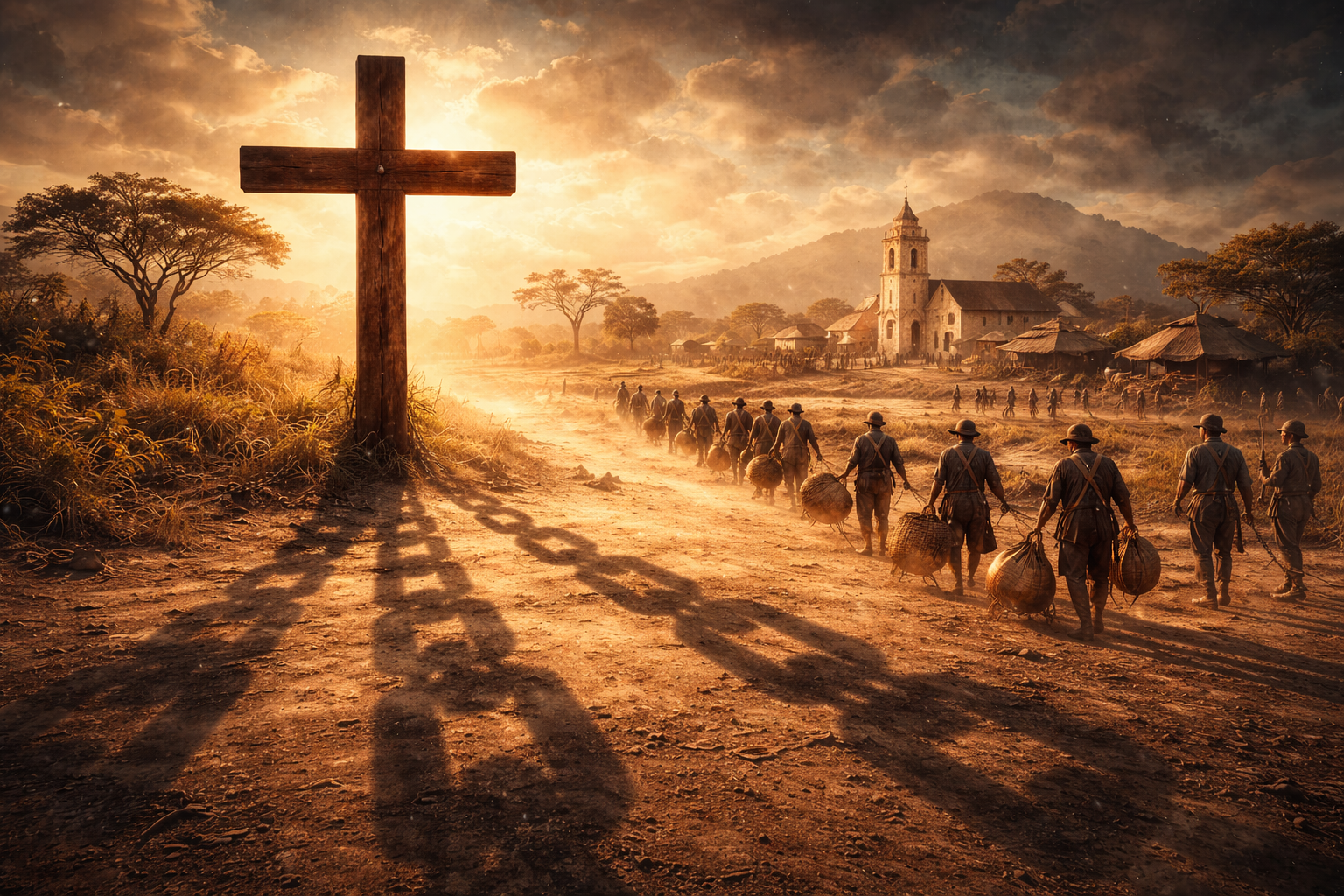
Prompt: In the context of colonisation of africa, how and when was forced labour introduced, how and when did the missionaries influence the colonies?
The Logic of the Chain: From Extraction to Productivity
Before the “Scramble for Africa” was formalized, European contact was defined by extraction without governance. Human beings were treated as cargo in the transatlantic slave trade; gold and ivory were siphoned through coastal forts.
However, as the 19th-century abolitionist movements gained ground, the logic of empire didn’t vanish—it recalibrated. The question shifted from “How do we extract people?” to “How do we extract productivity from the land?”
The Mechanism of Introduction (Post-1884)
Following the Berlin Conference (1884–85), European powers faced a “paper partition.” They owned vast lands but had no way to make them profitable. To solve this, they introduced forced labor through three primary levers:
- Taxation as Coercion: By imposing “Hut” or “Poll” taxes payable only in European currency, colonial states forced Africans into the wage labor market.
- The Concessionary System: Private companies (most notoriously in King Leopold II’s Congo Free State) were given “vacant” land and total authority. They used rubber quotas enforced by mutilation and terror.
- The Corvée: State-mandated labor for “public works”—railways, roads, and bridges—which was essentially slavery under a bureaucratic alias.
The Cross, the Coin, and the Chain
Colonisation was not chaotic conquest.
It was architecture.
It required:
- A theology.
- A labour system.
- A revenue model.
The colonisation of Africa rested on two visible pillars and one invisible mechanism:
- The chain — forced labour.
- The cross — missionary transformation.
- The coin — taxation and economic coercion.
Together, they created a self-reinforcing structure of extraction.
I. The Chain: Labour as Engine
Forced labour was not an accident of colonial excess.
It was the economic engine.
After the Berlin Conference (1884–85), European powers acquired enormous territories but lacked infrastructure and manpower. They needed roads, railways, plantations, mines.
They needed labour.
But they were unwilling to pay wages that would make such projects voluntary.
So they engineered compulsion.
Taxation as Coercion (Late 19th Century)
The brilliance of colonial policy was subtle.
Rather than enslave openly, administrators imposed Hut Taxes and Head Taxes — payable only in European currency.
To obtain that currency, Africans had to:
- Work on colonial farms.
- Enter mines.
- Build railways.
The coin became the leash.
No chain was visible.
But refusal meant imprisonment, confiscation, or violence.
Economic necessity replaced open slavery.
Concessionary Terror: The Congo Example
The most extreme case was the Congo Free State under King Leopold II (1885).
Private companies were granted vast territories to extract rubber.
The Force Publique enforced quotas through:
- Mutilation.
- Hostage-taking.
- Village burnings.
The brutality shocked Europe.
Yet it was not irrational cruelty.
It was quota-driven capitalism.
Production targets required fear.
Legalised Coercion: The Chibalo System
In Portuguese colonies like Mozambique and Angola, the Regulamento do Trabalho dos Indígenas (1899) formalised forced labour.
Anyone classified as “idle” could be conscripted.
Unemployment became criminal.
Freedom became conditional.
Contract Labour: Slavery Rebranded
Across French West Africa and British-controlled mining regions, multi-year labour contracts emerged.
Workers signed agreements they could not break.
These systems were often called:
- Engagés Délibérés
- Indentured labour
They were legal.
They were bureaucratic.
And they were coercive.
II. The Cross: Meaning as Infrastructure
If the chain disciplined the body,
the cross reorganised the imagination.
Missionaries arrived before administrators in many regions.
Among the most famous was David Livingstone, who promoted the “Three C’s”:
- Christianity
- Commerce
- Civilization
The order was not accidental.
Faith opened the door.
Commerce followed.
Administration consolidated.
Education as Soft Power
Missionaries held near-monopoly over Western education.
They built schools that taught:
- European languages.
- European history.
- European moral codes.
Students were told — explicitly or implicitly — that their traditions were inferior.
Salvation and civilisation became intertwined.
Mission education created a new African elite:
- Literate.
- Christian.
- Administratively useful.
Paradoxically, many future independence leaders were mission-educated.
The system trained its critics.
Medicine and Moral Authority
Hospitals demonstrated Western science.
Healing became evangelism.
When European medicine cured visible illness, it symbolically reinforced:
If their medicine works, perhaps their worldview does too.
Conversion was not always violent.
It was often persuasive.
And persuasion can be more durable than force.
Cultural Disruption
Missionaries:
- Opposed polygamy.
- Replaced customary courts.
- Dismissed indigenous spirituality as “pagan.”
Social structures shifted.
Marriage systems changed.
Authority structures realigned.
Identity was reframed.
This was not merely religious change.
It was civilisational recalibration.
III. Convergence: When the Cross Met the Chain
Forced labour required social stability.
Missionary education provided it.
Colonial administrators often relied on mission networks to:
- Translate.
- Teach obedience.
- Produce clerks.
- Encourage moral discipline.
Sometimes missionaries condemned brutality.
Other times, they legitimised empire under the rhetoric of the “civilising mission.”
But whether resisting or cooperating, they operated inside the same structure.
One extracted rubber.
The other extracted allegiance.
One built railways.
The other built moral scaffolding.
IV. Timeline of Structural Convergence
1500s–1800s: Extraction Without Governance
- Slave trade dominates.
- Coastal forts facilitate outward flow of labour.
Power = direct human extraction.
Early 1800s–1880s: Missionary Penetration
- Evangelical revival in Europe.
- Mission schools and translations expand inland.
- Christianity spreads before formal empire.
Power = moral and educational influence.
1885–1914: Forced Labour Systems Expand
- Berlin Conference partitions Africa.
- Taxation compels wage labour.
- Concessionary companies enforce quotas.
Power = administrative coercion.
1900–1945: Institutional Integration
- Labour systems bureaucratised.
- Mission education entrenched.
- Indigenous elites formed.
Power = integration of body and belief.
1945–1960s: Political Independence
- Forced labour formally dismantled.
- Mission-educated elites lead nationalist movements.
- Colonial flags fall.
But the economic orientation remains.
V. The Architecture of Order
Colonialism endured not merely because of violence.
It endured because it aligned:
- Economic coercion.
- Spiritual transformation.
- Administrative bureaucracy.
The body was taxed.
The soul was taught.
The system sustained itself.
When both labour and meaning are reorganised, resistance becomes structurally difficult.
Final Reflection
The chain alone cannot build empire.
It breeds rebellion.
The cross alone cannot sustain empire.
It lacks infrastructure.
But when taxation compels labour
and education reframes aspiration,
a system becomes quiet.
Colonial Africa was shaped not only by brutality,
but by architecture.
The cross gave the empire legitimacy.
The coin gave it leverage.
The chain gave it productivity.
And together they built a structure that outlived the flag.
Leave a Reply