
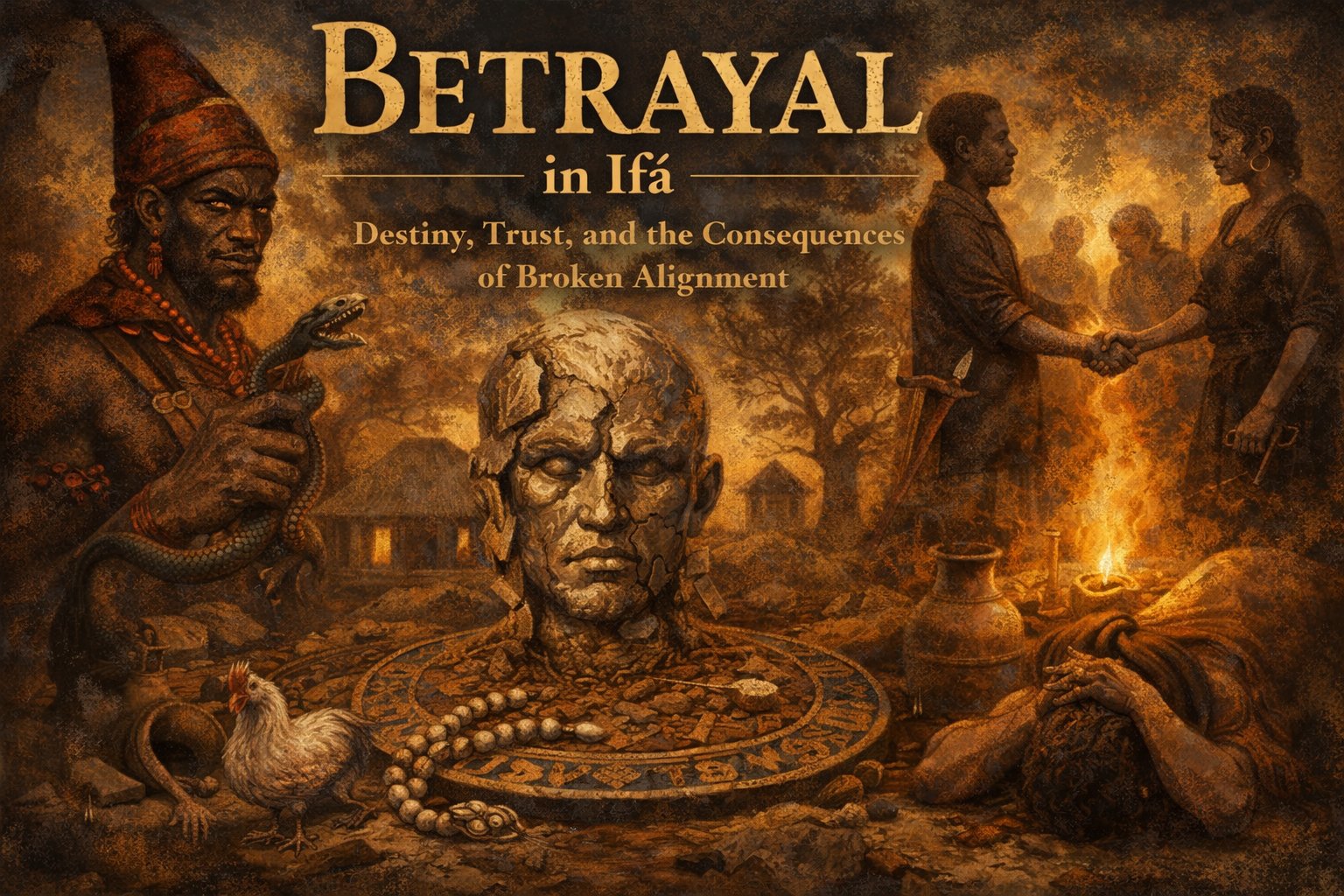
Betrayal in Ifá: Destiny, Trust, and the Consequences of Broken Alignment
In Ifá thought, betrayal is not primarily framed as moral failure in the abstract, nor as a legal transgression alone. Betrayal is understood as a rupture of alignment between person and person, person and community, and most critically, person and destiny (àyànmọ̀ / orí).
Where Abrahamic traditions often emphasise covenant with God, Ifá emphasises continuity with destiny, balance with the unseen, and fidelity to one’s chosen path before birth. Betrayal, therefore, is not simply an act against another it is an act against one’s own spiritual coherence.
Trust (Ìgbọràn and Ìwà Pẹ̀lẹ́) as the Foundation of Order
In Ifá, trust is rooted in character (ìwà), not promise. A person is trustworthy not because they swear loyalty, but because their inner nature consistently produces right action.
The concept of Ìwà Pẹ̀lẹ́ gentle, balanced, disciplined character is central. Betrayal emerges when ìwà deteriorates.
Ifá teaches:
- A person does not suddenly betray
- Betrayal grows from misaligned character
- Action follows inner imbalance
This is why Ifá prioritises who a person is over what they say.
Ìwà l’ẹ̀wà
Character is beauty.
A beautiful life cannot sustain betrayal without collapsing inward.
Betrayal as a Violation of Destiny (Orí)
In Ifá cosmology, every person chooses a destiny (orí inú) before entering the world. Life is the process of remembering and honouring that choice.
Betrayal occurs when:
- Desire overrides destiny
- Short-term gain eclipses long-term alignment
- Ego attempts to outsmart fate
To betray another unjustly is often to betray one’s own orí, inviting confusion, stagnation, or reversal.
Ifá verses repeatedly warn that no one escapes the witness of their orí. One may deceive people, but orí cannot be deceived.
Betrayal Is Never Isolated
In Ifá, betrayal is communal, not individualistic.
A betrayal:
- Weakens social trust
- Disturbs ancestral continuity
- Creates spiritual imbalance that spreads
This is why Ifá societies emphasised elders, witnesses, and ritual accountability. Betrayal was not merely “wrong” it was dangerous.
A person who betrays repeatedly becomes unreliable to the unseen, not just to humans.
Trickster Energy and Misused Intelligence
Ifá recognises intelligence, cunning, and strategy often embodied in the Òrìṣà Èṣù. But Èṣù is not the patron of betrayal; he is the guardian of consequence.
Betrayal arises when intelligence is used without wisdom:
- Cleverness without ìwà
- Strategy without balance
- Advantage without accountability
Ifá is clear:
Èṣù does not cause betrayal he exposes it.
When betrayal occurs, Èṣù ensures that:
- Truth surfaces eventually
- Masks collapse
- Consequences arrive at the correct time
Silence, Witness, and the Ancestors
In Ifá, betrayal is always witnessed:
- By ancestors (ẹ̀gún)
- By the unseen forces
- By one’s own destiny
Even when betrayal goes unpunished socially, it is recorded metaphysically.
This is why Ifá elders say:
“What you do in secret, you do in public just not at the same time.”
Time itself becomes the instrument of exposure.
Betrayal Against Hospitality and Sacred Relationship
One of the gravest forms of betrayal in Ifá is betrayal of:
- Hospitality
- Kinship
- Sacred trust
To eat with someone, to share palm wine, to invoke the same ancestors and then betray is considered spiritually corrosive.
Such acts fracture not just relationships, but ritual safety. This is why oaths, offerings, and witnesses were essential in traditional settings not because people were untrustworthy, but because trust was sacred.
Restoration Is Possible but Not Cheap
Unlike purely punitive systems, Ifá allows for restoration after betrayal, but never without cost.
Restoration requires:
- Acknowledgement (not denial)
- Sacrifice (material or symbolic)
- Behavioural change (proved over time)
- Re-alignment rituals (ẹbọ)
Forgiveness without correction is seen as naïve. Correction without mercy is seen as destructive. Balance is required.
Betrayal as a Test of Ìwà
Ultimately, betrayal in Ifá is a diagnostic event. It reveals:
- Who lacks inner balance
- Who cannot sustain power
- Who has drifted from destiny
Those betrayed are not defined by loss, but by how they respond:
- With patience or vengeance
- With wisdom or bitterness
- With alignment or collapse
Ifá teaches that destiny rewards endurance more than outrage.
Conclusion: Betrayal and the Law of Alignment
In Ifá, betrayal is not framed as rebellion against God, but as misalignment with destiny, character, and cosmic order.
Betrayal is costly because:
- Orí remembers
- Èṣù records
- Time delivers consequence
- Character determines outcome
A person may gain temporarily through betrayal, but Ifá insists that no gain obtained in misalignment can be sustained.
In the end, betrayal does not destroy destiny.
It reveals who has already abandoned it.
Character is destiny in motion.
Leave a Reply