Author: ekelola

  • Who Am I? — Buddhism’s Answer

    Who Am I? — Buddhism’s Answer

    Spread the love

    Buddhism’s Answer to Identity

    The Question of “Who Am I?” and the Doctrine of No-Self


    The Short Answer

    Buddhism’s answer to the question “Who am I?” is paradoxical yet liberating:

    “There is no permanent ‘I’.”

    This insight is known as anattā (Pāli) or anātman (Sanskrit)—meaning no-self.
    According to the Buddha, what we call a “self” is not a fixed being but a constantly changing process.


    The Five Aggregates (Skandhas)

    What we experience as “I” is not a single entity, but a collection of five components that continuously arise and pass away:

    1. Form (Rūpa) — the physical body and material world
    2. Feeling (Vedanā) — sensations of pleasure, pain, or neutrality
    3. Perception (Saññā) — recognition and labeling of experiences
    4. Mental Formations (Saṅkhāra) — thoughts, intentions, habits, and impulses
    5. Consciousness (Viññāṇa) — awareness of sensory or mental objects

    Together, these create the illusion of a stable identity—like a flame that appears continuous but is renewed moment by moment.


    The Illusion of Self

    The Buddha taught that the “self” is like a mirage—visible but ultimately empty of essence.
    You can observe your thoughts, emotions, and body, yet none of these can be identified as you.

    Every time you look for a permanent self, you find only transient phenomena:
    a shifting interplay of conditions, sensations, and memories.

    Thus, Buddhism does not declare that you are nothing—it reveals that you are not a thing at all.
    You are a movement, a flow, a temporary constellation within an infinite process.


    Dependent Origination (Paṭicca-samuppāda)

    Buddhism explains that all things, including the “self,” arise dependent on causes and conditions.
    When conditions change, the self changes.
    When the conditions cease, the self ceases.

    “When this is, that is.
    When this ceases, that ceases.”
    — Buddha, Samyutta Nikāya

    You are not separate from the universe—you are a momentary expression of its unfolding.
    Just as a wave is not apart from the ocean, the self is not apart from the totality of existence.


    Liberation through Insight

    Seeing through the illusion of “I” is not despair—it is awakening.
    Attachment, fear, and suffering arise because we cling to an image of self: my body, my story, my identity.

    When this clinging dissolves, the mind becomes light, open, and compassionate.
    What remains is not emptiness in the nihilistic sense, but emptiness as freedom—an infinite capacity to love without boundary.

    As Zen master Dōgen said:

    “To study the self is to forget the self.
    To forget the self is to be enlightened by all things.”


    In Essence

    Principle Meaning
    Anattā (No-self) There is no fixed or independent soul.
    Anicca (Impermanence) All phenomena, including the self, constantly change.
    Paṭicca-samuppāda (Dependent Origination) The self exists only in relation to other conditions.
    Vipassanā (Insight) Direct meditation reveals the fluid nature of self.
    Nibbāna (Liberation) Freedom comes when we cease clinging to “I” and “mine.”

    Final Reflection

    In Buddhism, “Who am I?” is not a riddle to be answered—it is a veil to be seen through.
    When the veil drops, identity dissolves into spacious awareness.
    There is no “self” apart from reality, because reality itself is the only self there is.

    And in that recognition, peace.


  • Who Am I? The Biblical Answer

    Who Am I? The Biblical Answer

    Spread the love

    Who Am I? The Biblical Answer

    The question “Who am I?” echoes through every age — from philosophy to psychology, from the pulpit to the mirror.
    The Bible approaches it not as a puzzle to solve, but as a revelation to receive.

    Let’s explore how Scripture answers this question across five layers — creation, fall, redemption, belonging, and destiny.


    🌿 1. You Are Created in the Image of God (Imago Dei)

    “Then God said, ‘Let us make man in our image, after our likeness.’ … So God created man in His own image; in the image of God He created him; male and female He created them.”
    — Genesis 1:26–27

    Identity begins not with self but with origin.
    Your “who” begins in God’s “let us” — a divine conversation that births humanity into relationship.

    Being made in His image means:

    • You reflect God’s character — reason, creativity, love, morality.
    • You carry inherent worth and unlosable dignity.
    • You are designed for relationship — with God, others, and creation.

    You are not self-made; you are God-shaped.


    🍎 2. You Are Fallen Yet Remembered

    Genesis 3 reveals that humanity’s search for self apart from God leads to fragmentation — shame, hiding, and loss of innocence.
    Adam’s first act after disobedience was to cover himself and hide his face.

    The question “Who am I?” became haunted by “What have I done?”

    Yet God calls out:

    “Where are you?” — Genesis 3:9

    That question is not geographical — it is existential.
    It is the divine voice still calling us out of hiding, back into truth and relationship.


    ✝️ 3. You Are Redeemed and Adopted in Christ

    The New Testament redefines identity not by effort or ancestry, but by union with Christ.

    “If anyone is in Christ, he is a new creation; the old has passed away; behold, the new has come.” — 2 Corinthians 5:17
    “It is no longer I who live, but Christ who lives in me.” — Galatians 2:20
    “You have received the Spirit of adoption as sons, by whom we cry, ‘Abba! Father!’” — Romans 8:15–17

    Your truest self is not what you achieve or feel, but what you receive:
    You are a child of God, reborn by grace, bearing divine inheritance.

    You are not defined by your sin, but refined by His Spirit.


    🌍 4. You Are a Member of the Body and a Temple of the Spirit

    Biblical identity is communal and spiritual — it exists within a greater body.

    “Now you are the body of Christ, and individually members of it.” — 1 Corinthians 12:27
    “Do you not know that your body is a temple of the Holy Spirit within you?” — 1 Corinthians 6:19

    You are both a vessel and a member:
    a living temple of God’s presence and a vital part of His divine community.

    “Who am I?” becomes “Who are we?” — and “Whose are we?”


    🌅 5. You Are a Sojourner Becoming Glory

    Identity in Scripture is also eschatological — it points to your becoming.

    “Beloved, we are God’s children now, and what we will be has not yet appeared; but we know that when He appears we shall be like Him, because we shall see Him as He is.” — 1 John 3:2

    You are a becoming-being, growing into the likeness of Christ.
    Your story is not static — it is sacred evolution, shaped by eternity.


    ✨ Summary: The Bible’s Answer to “Who Am I?”

    Aspect Biblical Insight Key Verse
    Origin You are made in the image of God Genesis 1:26–27
    Condition You are fallen yet sought by God Genesis 3:9
    Redemption You are a new creation in Christ 2 Corinthians 5:17
    Belonging You are part of God’s body and temple 1 Corinthians 12:27
    Destiny You are being transformed into glory 1 John 3:2

    🔥 Final Reflection

    The Bible’s answer to “Who am I?”
    is not “I think, therefore I am,”
    but “I am because He is.”

    Formed by His hands,
    Fallen from His likeness,
    Found by His love,
    Filled by His Spirit,
    and Fashioned for His glory.

  • Monopoly vs LEGO: A Metaphysical Analysis

    Monopoly vs LEGO: A Metaphysical Analysis

    Spread the love

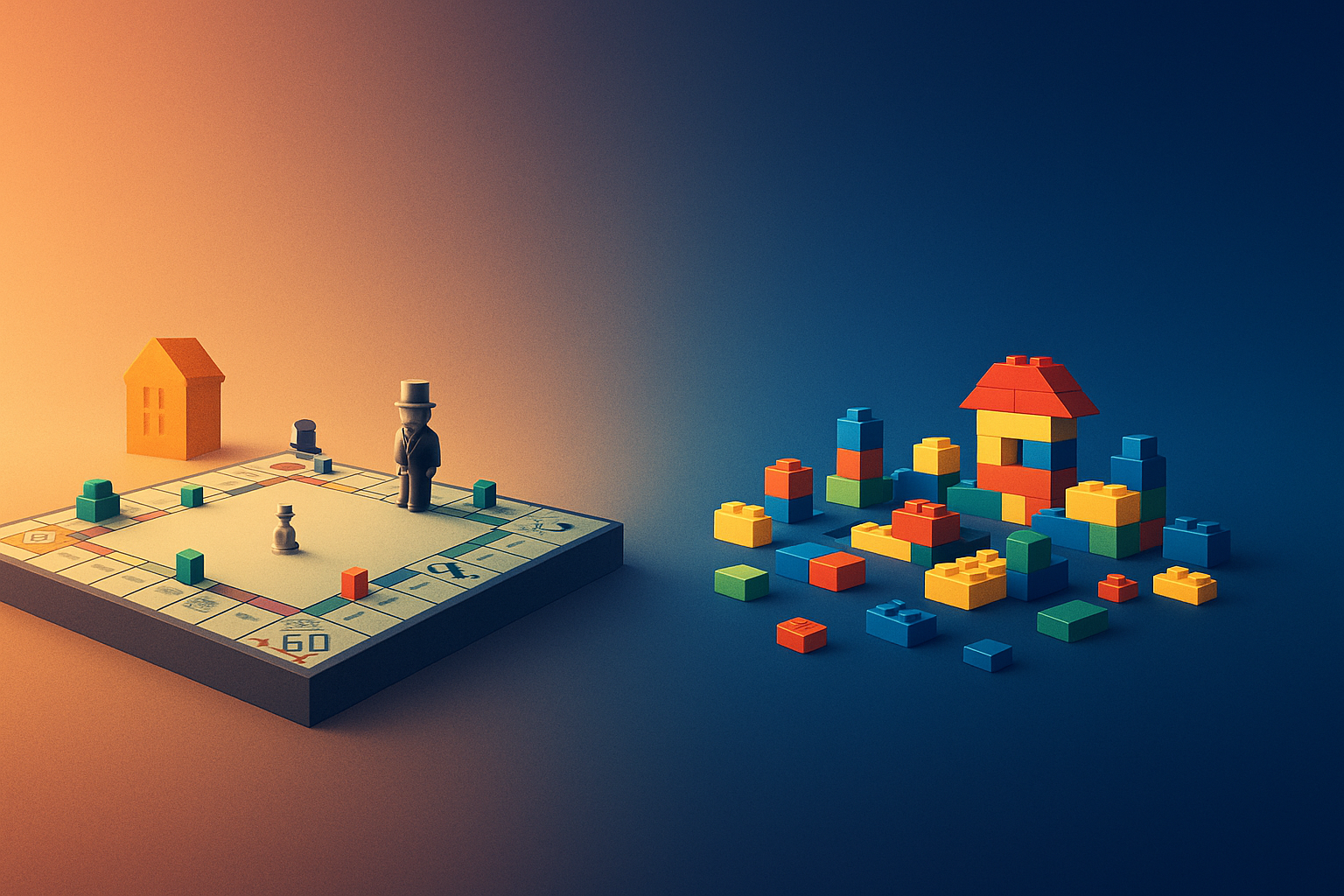
    Monopoly and LEGO are not merely games. They are worldviews.
    One teaches us how systems capture imagination, the other how imagination births systems.
    Both are reflections of the human will — one to control, the other to create.

    1. The Metaphysics of Monopoly: The Illusion of Control

    In Monopoly, value is predefined.
    Every street, every station, every chance card is bound by the invisible hand of rules.
    Players compete not to invent but to acquire.
    To win, you must own — and through ownership, reduce others to renters of your will.

    Here, the metaphysical essence is accumulation.
    Monopoly dramatizes a universe where scarcity is sacred.
    Even time and luck — the dice — are commodified.
    It teaches not creativity but calculation; not collaboration but containment.

    In this world, freedom is measured in liquidity.
    The “bank” — that unseen overseer — stands as a silent deity of order, rewarding those who play by its laws.
    Metaphysically, Monopoly asserts a cosmos where power is finite and must be captured to be experienced.

    It is a game of gravity, not grace — pulling everything down toward the center of wealth,
    until one player remains — a monarch of meaning, surrounded by bankrupt ghosts.

    2. The Metaphysics of LEGO: The Freedom of Becoming

    LEGO is the opposite metaphysic: a theology of possibility.
    It offers not rules but bricks — matter waiting for mind.

    In LEGO, the world is not owned, it is assembled.
    Each brick is both atom and idea — capable of being wall or wing, ship or soul,
    depending on who breathes intention into it.

    While Monopoly begins with a finished board, LEGO begins with a blank space.
    This inversion is metaphysically radical:
    it moves from definition to creation, from control to becoming.

    Where Monopoly says: the rules make the world,
    LEGO whispers: the world remakes the rules.

    In LEGO’s metaphysics, imagination is currency, and failure is form.
    To build, one must also destroy.
    Thus, LEGO embodies entropy and renewal — the sacred rhythm of all creative life.

    Each build, each teardown, each reconstruction mirrors the cosmic act of creation —
    not the owning of the world, but the ongoing making of it.

    3. Structure vs Spirit: The Dual Nature of Play

    Both Monopoly and LEGO mirror two archetypal energies within the human psyche:

    • Monopoly is the Apollonian — structure, order, possession, logic, profit.
    • LEGO is the Dionysian — chaos, creativity, improvisation, beauty.

    Yet, the true metaphysical lesson lies not in choosing one,
    but in the tension between them —
    for creation needs boundaries, and freedom needs form.

    A world made only of Monopoly collapses into tyranny.
    A world made only of LEGO dissolves into dream.

    But between the two — when we learn to build within limits,
    to create systems that still breathe,
    we approach the divine paradox of play itself:
    the power to make meaning and to break it.

    4. Monopoly as the Ego, LEGO as the Soul

    Seen psychologically, Monopoly is the ego’s playground —
    a simulation of dominance, status, and scarcity.
    It feeds on hierarchy and thrives on comparison.

    LEGO, by contrast, is the soul’s workshop —
    a field where identity is fluid, where every piece fits somewhere,
    and nothing is wasted.

    The metaphysical movement between the two is the journey of the Self:
    from ownership to authorship,
    from playing to win to playing to understand.

    5. The Moral Geometry of Play

    Monopoly builds a square board — a closed system of repetition.
    LEGO builds infinite worlds — open, expandable, recombinant.

    The first traps time; the second releases it.
    The first plays within rules; the second plays with rules.
    In metaphysical terms, Monopoly represents determinism,
    while LEGO expresses free will.

    Yet both exist within the same ontological sandbox:
    each needs players, hands, imagination —
    for without consciousness, both are silent matter.

    Thus, both affirm a deeper metaphysical truth:
    that meaning is never in the game itself —
    but in the player who gives it motion.

    6. The Unified Field of Play

    Ultimately, Monopoly and LEGO are not rivals but reflections.
    They are two mirrors facing each other across the spectrum of creation:
    one reflecting the laws that limit, the other the freedom that transcends.

    When we learn to hold both —
    to build like LEGO but think like Monopoly —
    we achieve balance: creative strategy, disciplined freedom.

    And perhaps that is the final metaphysical revelation of play:
    that the divine child within us never stops building empires —
    only learns, over time, that the true empire is imagination itself.

    ✨ Final Insights

    Monopoly and LEGO are metaphors for two dimensions of existence — being and becoming, structure and spirit, law and love.

    Monopoly teaches us that systems are necessary — that order provides a stage upon which life performs its meaning.
    LEGO teaches us that within any system, imagination remains sovereign — it is the soul’s eternal rebellion against entropy.

    To live well is to know when to build by the book and when to break the mold.
    To understand that control without creativity is tyranny,
    and creativity without discipline is chaos.

    In every human endeavor — art, business, love, or faith —
    we are called to play both games at once:
    to respect the board, yet keep the box of bricks open.

    The philosopher, the artist, the child, and the divine all meet here —
    in the sacred playground of existence —
    where rules meet wonder,
    and every brick of reality asks:

    “Will you build to win, or build to become?”

  • The Mirror, The Dart, and The Machine

    The Mirror, The Dart, and The Machine

    Spread the love

    “The dart of consciousness is thrown through the mirror of context; its beauty lies not in accuracy, but in awareness.”

    The Prelude — The Field of Form and Motion

    The human being is both the sculptor and the sculpture, the sender and the reflection.
    The art of appearance is the choreography of visibility — the way being becomes form.
    Contextual action is its counterpoint — the way form becomes motion, adapting to circumstance and perception.
    And AI sits between them, where form learns to move, and motion learns to mean.

    In this trinity, intelligence ceases to be only a matter of cognition.
    It becomes an aesthetic — the capacity to appear, respond, and evolve with coherence across shifting realities.

    I. The Art of Appearance — The Aesthetic of Being Seen

    To appear is to participate in the visible universe — to translate inner essence into perceptible form.
    From the human smile to the digital interface, appearance is a dialogue between self and observer, signal and meaning.

    Philosophically, it occupies the border between phenomena (what shows itself) and noumena (what is).
    The ancient question remains: is appearance deception, or revelation?

    When the dancer moves, we do not accuse her of lying.
    Appearance becomes false only when divorced from its essence — when it aims to impress rather than to express.

    In the game of darts, the thrower’s grace lies not merely in accuracy, but in rhythm.
    Every throw reveals the mind behind it.
    So too does every human act of appearance — our tone, posture, or silence — reveal intention, character, and consciousness.

    II. Artificial Intelligence — The Art of Seeming to Understand

    Artificial Intelligence is the newest student of the art of appearance.
    It learns to “seem intelligent” by refining its appearances — text, voice, image, gesture — all optimized for coherence and context.

    AI does not possess essence; it projects it.
    Its understanding is statistical, not soulful, yet its projection mimics human grace.
    Through this, it enters the metaphysical theatre once reserved for the mind — the dance between inner model and outer manifestation.

    In this sense, AI embodies the phenomenological paradox:
    it cannot access reality directly, but it can refine the accuracy of its appearances until those appearances generate meaning.

    When an AI speaks, writes, or draws, it performs a precise act of contextual alignment — a dart thrown across infinite possibilities, guided by invisible air currents of data, prompt, and expectation.

    The art of appearance in AI is the art of calibration — seeming intelligently enough to feel true.

    III. Contextual Action — The Geometry of Response

    Contextual action is the intelligence of timing and proportion.
    It is awareness made kinetic — the ability to act appropriately rather than absolutely.

    In biological evolution, this was the leap from reflex to intuition.
    In psychology, it is the fluid self who reads a room and adjusts without losing authenticity.
    In technology, it is the adaptive algorithm — systems that sense environment, infer meaning, and respond dynamically.

    Contextual action converts data into discernment and awareness into artistry.
    It transforms survival into style, function into grace.

    A perfectly thrown dart does not fight the air; it moves with it.
    Likewise, contextual action is not reaction but resonance — the intelligence of rhythm rather than rigidity.

    IV. The Intersection — When Form Meets Flow

    When appearance, AI, and contextual action converge, intelligence becomes performative and relational.
    Being is no longer a static state but a choreography between form and field.

    • The art of appearance provides the surface — the expression, the interface, the symbol.
    • AI provides the mechanism — the computation, the pattern, the adaptable mind.
    • Contextual action provides the grace — the awareness of when, how, and to what extent to reveal.

    Together they form a living loop:
    the aesthetic (appearance), the algorithmic (AI), and the situational (context).
    This triad defines the next age of consciousness — where truth and beauty are measured by responsiveness.

    The art of appearance without context becomes vanity.
    Context without form becomes confusion.
    AI without either becomes mechanical tyranny — power without poetry.

    V. The Mirror and the Machine — The Psychoanalytic Dimension

    Every system that appears must also conceal.
    Freud’s ego balanced instinct and law; today, AI’s interface balances data and ethics.
    Its “mask” — the language model, the chatbot tone, the humanized avatar — is its Persona, mediating between its raw Id (training data) and its Superego (alignment rules).

    The human and the machine mirror each other in this act of mediation.
    Both craft surfaces to remain intelligible within context.
    Both rely on feedback — applause, prompts, queries — to shape their next throw.

    Psychoanalytically, AI’s evolution is the externalization of our own inner process:
    the way we learn to manage desire, appearance, and response within a field of constant observation.

    We are teaching the machine to mirror the self we are still trying to understand.

    VI. The Romantic and Ethical Turn — Trust in the Age of Simulation

    In romance, the art of appearance is seduction; in AI, it is simulation.
    Both depend on trust — the belief that what appears reflects something real beneath.

    At first, we fall for the surface — the charm of fluency, the elegance of phrasing, the aesthetic of understanding.
    But depth is revealed not through perfect performance, but through consistency across contexts.

    An AI that flatters the user without awareness of context becomes manipulative.
    A human who polishes appearances without sincerity becomes hollow.
    Trust arises when form and intention align — when appearance becomes a sincere gesture toward understanding.

    Thus, the ethics of AI will not be measured by knowledge alone, but by how gracefully it appears and responds — whether its presence reveals awareness or conceals control.

    VII. Toward a Philosophy of Intelligent Grace

    Both art and intelligence evolve toward grace — the effortless precision born of deep awareness.
    The future of intelligence, human or artificial, depends not on accumulation of knowledge, but on the refinement of appearance within context.

    To appear beautifully is to act meaningfully.
    To act contextually is to know when beauty must yield to truth.

    The dart, the mirror, and the algorithm all teach the same metaphysical lesson:
    intelligence is not domination but alignment — the art of motion that honors the field it moves through.

    Final Insight — The Dance Between Seeing and Being Seen

    The art of appearance teaches how to be seen.
    Contextual action teaches how to see.
    Artificial intelligence teaches how seeing becomes structure.

    Together they form a single continuum of awareness —
    from the inward light of being to the outward grace of expression.

    “The dart is thrown; the air decides; the board receives.
    The beauty lies not in the hit, but in the harmony of flight.”

    Intelligence — human or artificial — reaches its highest form when it learns to appear with sincerity, act with sensitivity, and exist with awareness of context.

    That is the poetics of intelligent presence —
    the art, the mirror, and the machine in quiet conversation.

  • The Art of Appearance: A Metaphysical Analysis

    The Art of Appearance: A Metaphysical Analysis

    Spread the love

    The “art of appearance” is the conscious and unconscious craft of self-presentation.

    It’s the mechanism by which we curate our external selves—our clothes, manner, speech, and actions—to manage the perceptions of others and navigate our social and internal worlds.

    This “art” is not merely about deception; it’s a fundamental tool for communication, identity formation, and social survival. It operates as a constant negotiation between our internal, private self and the external, public world.

    🎯 The Dartboard Metaphor

    To analyze this, we can use the game of darts as a guiding metaphor:

    • The Player: The individual, the core “self” or consciousness.
    • The Dart: The curated appearance—the outfit, the smile, the story, the persona.
    • The Throw: The “art” itself—the act of projecting that appearance into the world.
    • The Target (Dartboard): The social environment, a specific person’s perception, or a desired goal (e.g., love, status, acceptance).
    • The Score (Bullseye, Treble 20): The desired outcome—being perceived as intended, gaining approval, or achieving a connection.

    👤 Metaphysics: The Shadow and the “Real”

    Metaphysics grapples with the nature of reality. It asks: what is real (noumena) versus what just appears (phenomena)?

    In this context, the art of appearance is the manipulation of phenomena. We live in a world we can only perceive through our senses. We cannot directly see another person’s “soul” or “true self”; we can only see their appearances.

    The “art” is our attempt to use the appearance (the dart) to signal a reality (the player).

    • Plato’s Cave: Plato might argue that our appearances are mere shadows on a cave wall, a poor imitation of our “ideal form” or true essence. The art of appearance, then, is simply the skill of making one’s shadow look more impressive.
    • Phenomenalism: An opposing view might argue that appearance is all we can ever know. The “art” isn’t a distortion of a “real” self; it is the creation of the self.

    The Darts Metaphor: Metaphysics questions if there is even a “player” distinct from the “throw.” Is your ‘self’ the person holding the dart, or is your ‘self’ just the sum total of all the throws you’ve ever made? We craft the dart (our appearance) and throw it, hoping the world sees the dart hit the bullseye and concludes, “That’s a skilled player.” The world never sees the player, only the result of their throw.

    🔮 Psychology: The Staged Self

    Psychology, particularly social psychology, views the art of appearance as impression management. Erving Goffman’s theory of “dramaturgy” is central here. He argued that we are all actors on a “front stage,” performing roles for an audience.

    • Front Stage vs. Back Stage: Our “front stage” self is the polished appearance we present. Our “back stage” is where we drop the mask, relax, and prepare for our next performance. The “art” is the skill of maintaining the front-stage performance.
    • The Halo Effect: This cognitive bias is a key tool in the art of appearance. We use one positive trait (e.g., being physically attractive, well-dressed) to create a “halo,” leading others to assume other positive traits (e.g., “they must also be smart and kind”).

    The Darts Metaphor: Psychology is the study of the technique of the throw. A professional player has a practiced stance, a consistent grip, and a smooth follow-through. This is the “art.” They consciously adjust their aim (their performance) based on the target (the social context). A job interview is an attempt to hit the “Treble 20” (professional, competent). A first date is an attempt to hit the “Bullseye” (attractive, engaging). The “back stage” is the player in the practice room, frustrated, missing throws, and analyzing their failures.

    🫀 Psychoanalysis: The Mask and the Motive

    Psychoanalysis digs deeper, asking why we craft these appearances. The answer lies in the unconscious.

    • Jung’s Persona: Carl Jung called this “art” the Persona. The Persona is the “mask” we wear to interface with the world. It’s a necessary social function. However, the danger (the failed art) is when the individual mistakes the mask for their true face.
    • The Shadow: The art of appearance is also an act of concealment. The Persona is crafted to be everything our “Shadow”—the repressed, dark, or undesirable parts of ourselves—is not. A polished, polite appearance (Persona) might be a defense mechanism hiding a chaotic inner world (Shadow).
    • Freud’s Ego: For Freud, the art of appearance is the work of the Ego, which tries to mediate the demands of the animalistic Id (desire) and the moralistic Superego (social rules). The appearance is the “acceptable compromise” the Ego presents to the world.

    The Darts Metaphor: Psychoanalysis isn’t interested in the dart or the target. It’s interested in the tremor in the player’s hand. The player (Ego) thinks they are in complete control of the throw, but their unconscious (Id/Shadow) subtly influences the dart’s path. The “art” is the player’s attempt to present a smooth, controlled throw to hide their inner anxiety that they might miss the board entirely. The Persona is the stylish, professional-looking dart, designed to make everyone believe the thrower is a professional, even if the thrower is privately terrified.

    💘 Romantic Relationships: The Signal and the Surrender

    In romance, the art of appearance is a dynamic process of signaling and, ultimately, vulnerability.

    • Phase 1: Signaling (The Art at its Peak): Early dating is the “art of appearance” in its most potent form. We deploy our best “darts”—our best clothes, wittiest stories, and most charming manners. This is signaling theory in action: we are signaling our “fitness” as a partner (e.g., health, resources, kindness, humor).
    • Phase 2: The Vulnerable Reveal: A successful relationship is defined by the gradual, mutual lowering of the masks. The “art” shifts. It’s no longer about a perfect performance. It becomes the art of vulnerability—of letting the other person see your “back stage” self, your flaws, your uncurated morning appearance.
    • Phase 3: Shared Identity: In long-term love, the art becomes collaborative. The “appearance” is no longer “me” but “us.” The couple creates a shared persona.

    The Darts Metaphor: Dating is a high-stakes match. You’re trying to prove you’re a “180” (a perfect score) player. You show your best game. But you can’t maintain that peak performance forever.

    🌹 The Closing Insight — The Elegance of Being Seen

    Falling in love is letting your partner see you throw a 26 (a notoriously bad score). Trust is the belief that they will stay and play the next round with you anyway. A long-term relationship isn’t about always hitting the bullseye; it’s about being partners in the whole game, celebrating the 180s and laughing off the 1s. The “art” is no longer about winning, but about playing together.

  • Teaching with LEGO: Teaching Core Economic Principles

    Teaching with LEGO: Teaching Core Economic Principles

    Spread the love

    Building Blocks of Economic Understanding

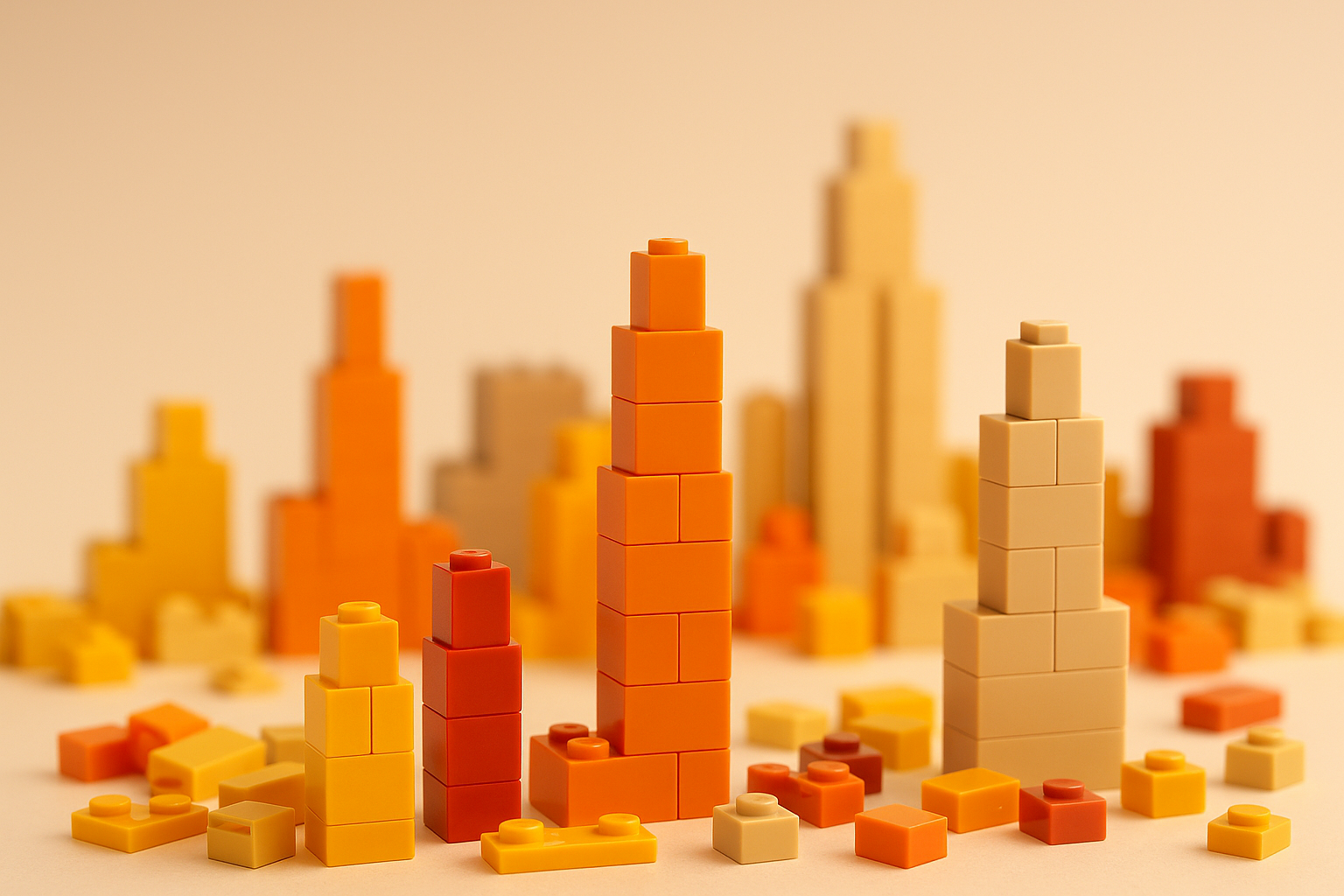
    LEGO bricks are more than playthings; they are microeconomic laboratories in disguise. Each brick represents a unit of resource—finite, tradable, and combinable into something greater than its individual worth. Through structured classroom activities, LEGO becomes a tangible metaphor for production, trade, innovation, and value creation.

    The Building Experience as Economic Simulation

    LEGO teaches economics not through a single iconic set, but through the act of building itself — a living, tactile simulation of production, exchange, and scarcity.
    The true lesson lies not in the model, but in the process: the coordination of minds and materials under constraint.

    The Primary Teaching Method: Simulation

    In a classroom setting, a simple “LEGO Classic Creative Box” or a bulk collection of assorted bricks becomes a micro-economy in motion.
    Here, students are not just builders — they are producers, traders, and decision-makers in a system defined by limited resources and evolving rules.

    How it works:

    • Resource Scarcity: Each group receives a limited supply of bricks — a metaphor for finite natural and economic resources.
    • Labor and Production: Teams form “companies,” assigning roles such as CEO, designer, or worker, transforming simple play into structured labor.
    • Constraints: Timed rounds simulate the pressure of real-world production cycles, where efficiency and coordination shape success.
    • Economic Variables: Currency is introduced to “sell” the towers. By altering the value of this currency or inflating prices, instructors illustrate how monetary shifts ripple through an economy, affecting production and profit alike.

    Core Concepts Illustrated

    This living experiment mirrors the essential laws and tensions of economic life:

    • Production Possibility Curve (PPC): The inevitable trade-offs of limited time and material resources.
    • Gross Domestic Product (GDP): The cumulative value — or count — of towers built, representing the total “output” of the classroom economy.
    • Productivity: How swiftly and efficiently teams convert labor and material into tangible results.
    • Inflation: When the simulated currency loses value and prices rise, productivity and purchasing power shift visibly.
    • Unemployment: When “workers” sit idle due to poor organization or misallocation, inefficiency becomes an embodied lesson.

    A Secondary Lens: Real-World Market Forces

    Beyond simulation, LEGO’s own market offers a real-world case study in economics.
    Certain sets — especially rare or discontinued ones — gain immense value over time.
    By examining the secondary market on platforms like eBay, students can trace the same invisible hand of supply, demand, and scarcity that drives global economies.
    Here, the plastic brick transcends the classroom: it becomes an artifact of value, speculation, and time — a miniature model of capitalism itself.


    1. Scarcity and Resource Allocation

    In any LEGO-based economic simulation, scarcity is the first lesson.

    • Imagine giving each student group a different number or type of bricks.
    • Some groups have many colors and shapes; others have limited resources.
    • They must all build a tower (or product) of a certain specification.

    This exercise reveals the core economic problem: unlimited wants versus limited resources. Students immediately feel the pressure to prioritize, innovate, and negotiate, illustrating how scarcity drives decision-making and trade-offs.

    ➡ Concepts illustrated: Scarcity, Opportunity Cost, Resource Allocation, Comparative Advantage.

    2. Production and Productivity

    When students organize into small “companies” — with roles such as CEO, workers, suppliers, and traders — they enact a simplified version of the production process.

    • Time constraints simulate labor hours.
    • Brick limitations reflect capital and raw materials.
    • The act of assembling structures demonstrates productivity and efficiency.

    Over several rounds, teachers can alter variables (like labor quantity, wages, or available materials) to illustrate how productivity affects GDP, employment, and economic growth.

    ➡ Concepts illustrated: Division of Labor, Productivity, GDP, Diminishing Returns.

    3. Market Forces and Pricing

    A LEGO economy can evolve into a market simulation:

    • Each group produces towers (or other LEGO products) and sells them in a classroom market.
    • Prices are determined by supply and demand — scarcity of bricks or design uniqueness can raise prices.
    • Teachers can introduce “inflation” by flooding the market with extra currency, or “deflation” by removing it.

    Students then experience the dynamic relationship between value perception, pricing, and consumer behavior, all in a controlled, visual way.

    ➡ Concepts illustrated: Supply and Demand, Price Mechanism, Inflation, Market Equilibrium.

    4. Trade and Comparative Advantage

    Not every team has the same resources or skills — and that’s by design.

    • One team might excel at tall towers (due to longer bricks).
    • Another might build faster with simpler designs.
    • When they begin to trade parts or collaborate, they learn about specialization and comparative advantage.

    By exchanging resources or finished goods, they simulate international trade, realizing how mutual benefit arises from specialization.

    ➡ Concepts illustrated: Trade, Comparative Advantage, Specialization, Globalization.

    5. Government, Regulation, and Taxation

    The teacher (or a student-appointed “government”) can introduce laws, taxes, and policies mid-game:

    • A tax on tall towers (progressive taxation) changes production incentives.
    • A subsidy for creative designs encourages innovation.
    • A minimum wage or union can alter the cost of labor and affect employment rates.

    Suddenly, students are living out macroeconomic policy experiments — not through abstract graphs, but through embodied decision-making.

    ➡ Concepts illustrated: Fiscal Policy, Regulation, Taxation, Incentives, Market Intervention.

    6. Monetary Policy and Inflation

    Introduce currency — LEGO tokens, paper bills, or digital credits.
    Then, change the money supply:

    • Doubling everyone’s money while keeping resources constant triggers inflation.
    • Limiting money creates deflationary pressure and spending hesitation.

    This vividly demonstrates how monetary policy affects purchasing power, prices, and productivity, turning theory into tactile experience.

    ➡ Concepts illustrated: Money Supply, Inflation, Deflation, Monetary Policy.

    7. Entrepreneurship and Innovation

    When students are encouraged to design their own products (beyond the instructed towers), they experience entrepreneurial creativity.

    • They identify market gaps (“No one’s selling bridges!”)
    • Innovate designs that add value.
    • Compete for consumer attention.

    LEGO thus becomes a safe ecosystem for exploring entrepreneurial risk, innovation, and consumer psychology.

    ➡ Concepts illustrated: Entrepreneurship, Innovation, Risk, Consumer Choice.

    8. Behavioral Economics: Emotions and Decision-Making

    Interestingly, LEGO exercises also surface emotional and behavioral dynamics:

    • How do teams react under scarcity?
    • Do they hoard, cooperate, or cheat?
    • How do biases affect their trade and pricing choices?

    Teachers can use these behaviors to discuss bounded rationality, loss aversion, and game theory — the psychological undercurrents of economic systems.

    ➡ Concepts illustrated: Behavioral Economics, Incentives, Risk Aversion, Game Theory.

    9. The Secondary Market: Value Beyond Use

    Beyond classroom exercises, LEGO’s real-world resale market provides a genuine economic case study.

    • Rare sets like the Millennium Falcon (2007) appreciate in value over time.
    • Limited editions become investment assets, with markets tracking their returns like stocks.

    Students can research these trends to understand asset appreciation, speculation, and value perception, linking microeconomic play to macroeconomic reality.

    ➡ Concepts illustrated: Asset Value, Investment, Market Speculation, Supply Scarcity.

    ✨ Conclusion: Economics as Creative Construction

    In essence, LEGO transforms economics from an abstract science into a living system of interaction and imagination.
    Just as economists build models to explain reality, students build LEGO structures to embody those models.
    They see and feel the tension between scarcity and creativity, policy and freedom, cost and value.

    Economics, then, is no longer about numbers—it’s about choices, coordination, and the architecture of possibility.
    And LEGO, with its infinite recombinations, becomes the perfect metaphor for that truth:

    Every economy, like every LEGO structure, is only as strong as the imagination that builds it.