
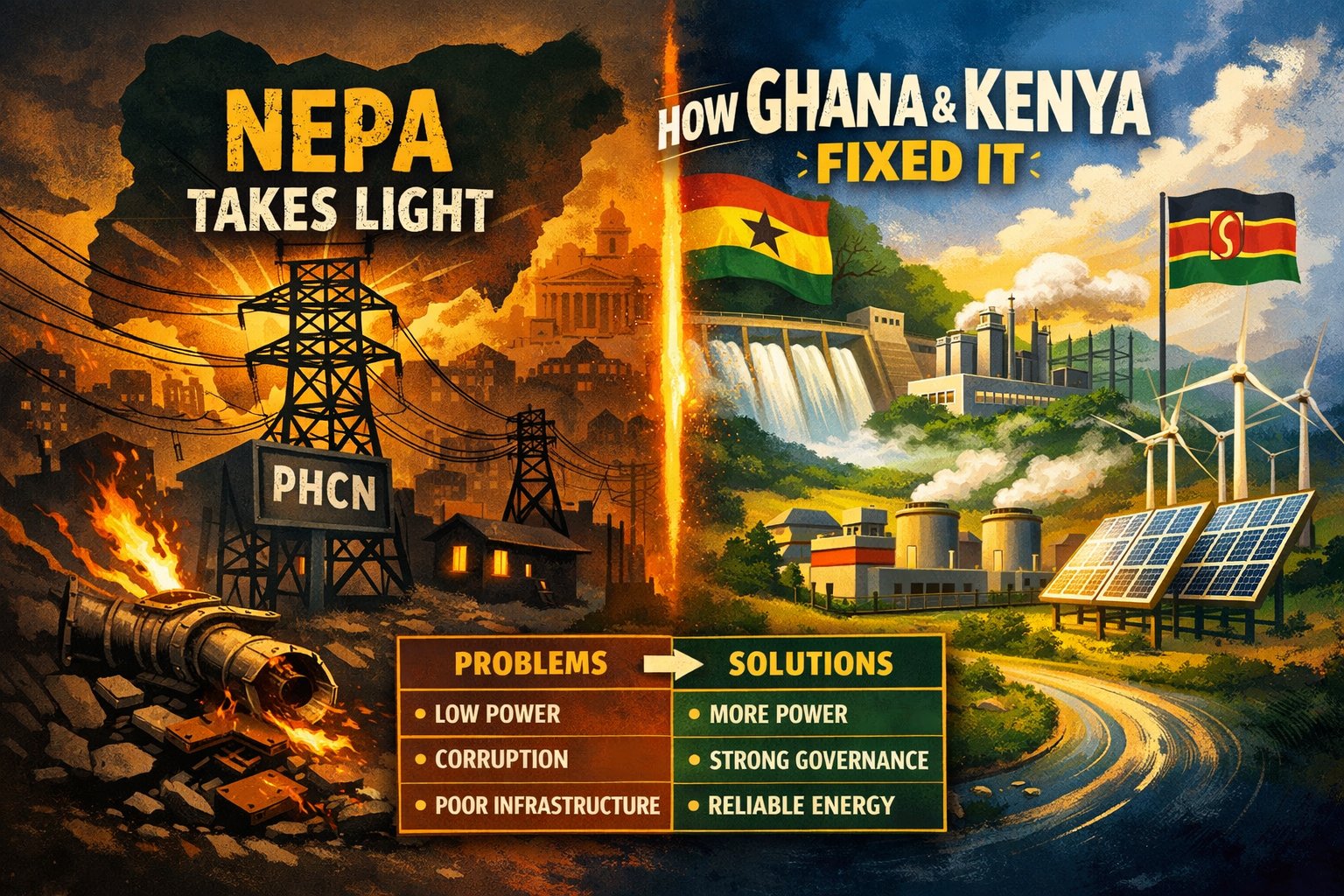
Why NEPA Takes Light in Nigeria — And Why Ghana and Kenya Didn’t Accept the Same Fate
In Nigeria, NEPA—now formally dissolved into PHCN, with responsibilities split across Generation Companies (GenCos), the Transmission Company of Nigeria (TCN), and Distribution Companies (DisCos)—“takes light” primarily due to deep structural weaknesses across the entire electricity value chain.
These problems are not mysterious, accidental, or unavoidable. They are systemic, long-standing, and well understood.
What follows is a clear, factual explanation.
Why Electricity Fails in Nigeria
1. Insufficient Power Generation
Nigeria has a population exceeding 200 million people, yet the country often produces less than 5,000 megawatts (MW) of usable electricity.
This level of generation is grossly inadequate to serve:
- Residential demand
- Commercial activity
- Manufacturing
- Healthcare
- Public infrastructure
When demand significantly exceeds supply, load shedding becomes inevitable. Electricity is rationed not because of a single fault, but because there simply is not enough power to go around.
2. A Weak and Overstretched Transmission Network
Even when electricity is generated, Nigeria frequently cannot move it efficiently across the country.
The national transmission grid suffers from:
- Aging infrastructure
- Overloaded transmission lines
- Poor maintenance
- Limited redundancy
A fault in one region can cascade across multiple states, sometimes resulting in nationwide outages. This fragility explains why power can be lost suddenly, without warning, across large areas of the country.
3. Distribution Company (DisCo) Constraints
Distribution Companies are responsible for delivering power from substations to homes and businesses. This is often where electricity fails to reach consumers.
Common issues include:
- Overloaded transformers
- Dilapidated or stolen cables
- Rapid urban expansion without corresponding infrastructure upgrades
As a result, electricity may reach a neighbourhood but still fail to reach individual households.
4. Gas Supply Disruptions
The majority of Nigeria’s power plants are gas-fired.
This makes electricity generation highly vulnerable to:
- Pipeline vandalism
- Gas theft
- Supply interruptions
When gas supply stops, power plants shut down almost immediately.
No gas means no generation.
No generation means no light.
5. Poor Maintenance Culture
Much of Nigeria’s electricity infrastructure is:
- Several decades old
- Poorly maintained
- Repaired reactively rather than proactively
Preventive maintenance is rare. Components are often only fixed after failure, leading to frequent breakdowns and prolonged outages.
6. Debt and Financial Instability
The power sector suffers from chronic revenue shortfalls.
Key contributors include:
- Non-payment of electricity bills
- Meter bypassing
- Electricity theft
Because revenue collection is weak:
- DisCos struggle to maintain infrastructure
- GenCos lack capital to expand or upgrade plants
- The entire system remains underfunded and fragile
7. Load Shedding (“Sharing Light”)
When available electricity cannot meet demand, power is rotated between areas.
Typically:
- Area A receives electricity
- Area B is switched off
- Then the cycle reverses
This explains why electricity may appear on a schedule—or disappear without notice.
8. Policy Inconsistency and Corruption
Over several decades, Nigeria’s power sector has been undermined by:
- Inconsistent government policies
- Weak regulation
- Political interference
- Corruption
These factors discouraged long-term investment and prevented meaningful reform from taking root.
In Summary
NEPA takes light because Nigeria’s electricity demand vastly exceeds what its aging, underfunded, and poorly maintained power system can reliably supply.
How Ghana and Kenya Tackled Similar Problems
Ghana and Kenya did not solve their electricity challenges through luck or miracles. They made deliberate, difficult, and sustained structural reforms.
The difference lies in execution, discipline, and consistency.
🇬🇭 Ghana’s Response to “Dumsor”
Between 2012 and 2016, Ghana faced a severe power crisis popularly known as “Dumsor”—persistent, unpredictable blackouts.
1. Power Was Treated as a National Emergency
The Ghanaian government:
- Publicly acknowledged the crisis
- Set clear generation and delivery targets
- Centralised decision-making for speed and coordination
While Nigeria debated, Ghana mobilised.
2. Aggressive Expansion of Generation Capacity
Ghana invested heavily in:
- Thermal power plants (gas and oil)
- Improved hydroelectric reliability (Akosombo and Bui dams)
- Independent Power Producers (IPPs)
As a result, Ghana now frequently generates more electricity than it consumes.
3. Securing Fuel Supply
Ghana reduced generation risk by:
- Investing in gas infrastructure
- Leveraging regional agreements such as the West African Gas Pipeline
- Minimising dependence on vulnerable pipelines
Nigeria, despite abundant gas reserves, still struggles with delivery reliability.
4. Enforced Revenue Collection
Ghana implemented:
- Widespread prepaid metering
- Strict penalties for illegal connections
- Greater billing transparency
Utilities were expected to function commercially, not politically.
5. Policy Continuity Across Governments
Crucially, successive governments continued the same power-sector reforms rather than resetting them.
🇰🇪 Kenya’s Even More Disciplined Approach
Kenya’s success is notable given its limited fossil fuel resources.
1. Strategic Investment in Renewable Energy
Kenya prioritised:
- Geothermal energy (now a continental leader)
- Wind power (Lake Turkana Wind Project)
- Solar energy
This reduced exposure to fuel imports, vandalism, and price volatility.
2. Strong, Independent Utilities
Kenya Power and Lighting Company (KPLC):
- Operates with commercial discipline
- Disconnects non-paying customers
- Maintains professional standards and accountability
Political interference is limited.
3. Transmission Infrastructure First
Kenya invested early in:
- Transmission lines
- Grid expansion
- Rural electrification
Electricity was designed to reach consumers, not just generation sites.
4. Investor Confidence and Regulatory Stability
Kenya offered:
- Clear contractual terms
- Predictable regulations
- Minimal policy reversals
Investors trusted the system.
5. Electricity as Economic Infrastructure
Power was treated like:
- Roads
- Ports
- Airports
Not as a political favour.
The Uncomfortable Comparison
| Issue | Ghana & Kenya | Nigeria |
|---|---|---|
| Policy consistency | High | Low |
| Revenue enforcement | Strong | Weak |
| Maintenance approach | Planned | Reactive |
| Corruption tolerance | Lower | Higher |
| Political interference | Limited | Heavy |
Can Nigeria Fix This?
Yes. Nigeria has more resources than Ghana and Kenya combined.
But reform would require:
- Cost-reflective tariffs with targeted subsidies
- Universal metering
- Protection of gas infrastructure
- Major investment in transmission
- Removal of political interference
- Long-term planning beyond electoral cycles
Bottom Line
Ghana and Kenya did not fix electricity because they were richer.
They fixed it because they were more serious, more disciplined, and more consistent.
Electricity did not become perfect.
It became reliable enough to support a modern economy.
And that, ultimately, is the difference.
Leave a Reply