
Journal ·
The Esoteric Essence of Scooby-Doo
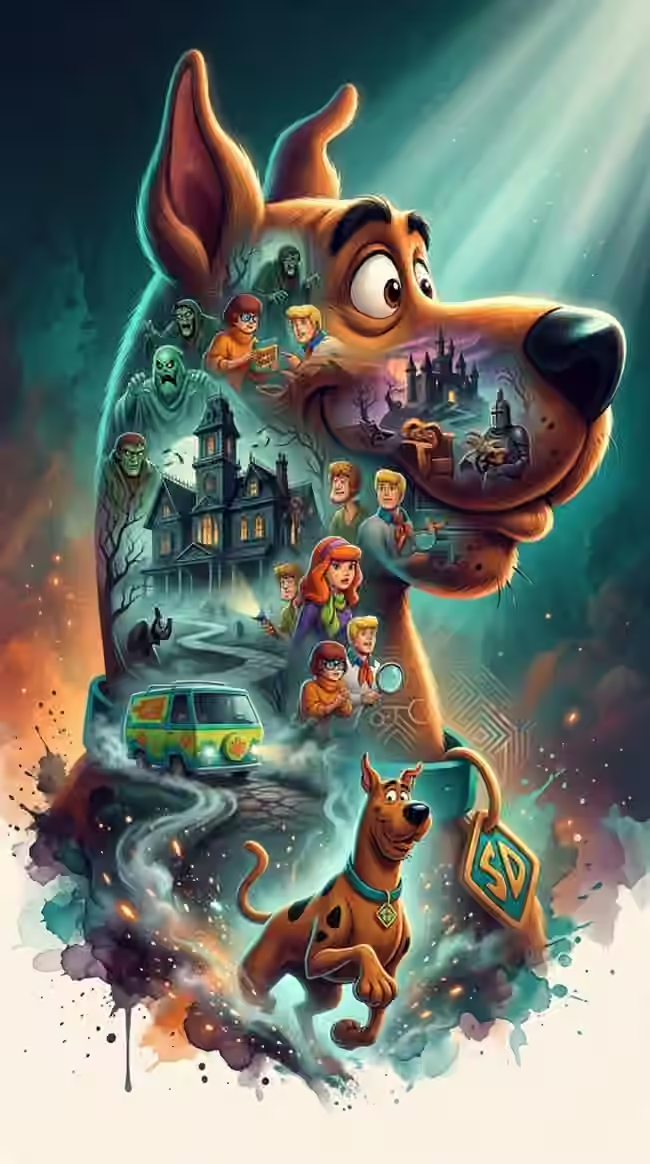
In this article
The esoteric essence of Scooby-Doo is surprisingly profound.
Beneath the comedy, talking dog, haunted houses and seemingly supernatural monsters lies a recurring philosophical proposition:
Humanity is often imprisoned not by what is real, but by what it has been conditioned to fear.
And the path to liberation is the pursuit of truth.
1. The mask: illusion versus reality
The defining ritual of the original 1969 series is the unmasking.
A terrifying supernatural entity is revealed to be an ordinary human manipulating appearances for personal gain.
Symbolically:
- The monster represents manufactured fear.
- The mask represents deception, illusion and false authority.
- The haunting represents psychological manipulation.
- The investigation represents the pursuit of knowledge.
- The unmasking represents enlightenment.
The striking element is that the apparent supernatural evil is frequently a human exploiting other humans.
This makes Scooby-Doo an unusually accessible allegory for what philosophy calls epistemology: how we distinguish what is true from what merely appears to be true.
In the original programme, apparently supernatural threats were generally exposed as criminals in disguise.
2. The five investigators: a symbolic model of consciousness
From a Jungian or esoteric perspective, we can interpret the five principal characters as different faculties of the human mind.
| Character | Symbolic faculty |
|---|---|
| Fred | Will, order, leadership and deliberate action |
| Velma | Reason, intellect and analytical discernment |
| Daphne | Perception, intuition and social awareness |
| Shaggy | Vulnerability, appetite and the fearful human ego |
| Scooby | Instinct, loyalty and primal intelligence |
This is an interpretive reading, rather than an officially established symbolism.
What interests me particularly is that Velma alone cannot solve every mystery.
Reason needs instinct. Leadership needs perception. Courage requires acknowledging fear.
The gang succeeds through the integration of different faculties rather than the supremacy of one.
That resembles the philosophical idea of psychological individuation: becoming more complete by integrating different aspects of oneself.
3. Scooby and Shaggy: the wisdom of the fearful
There is a fascinating paradox at the heart of the franchise.
Scooby and Shaggy are its most frightened characters, yet they repeatedly contribute to resolving the mystery.
In mystical and philosophical traditions, the holy fool or trickster can expose truths that more respectable, rigidly rational figures overlook.
Scooby and Shaggy embody something similar.
Their apparent weakness becomes a source of discovery.
Courage does not necessarily begin with fearlessness. It can begin with moving despite fear.
This is arguably one of the franchise’s most enduring philosophical lessons.
4. The deeper political symbolism: fear as an instrument of control
Look at the recurring plot structure:
An individual desires wealth, property or power
The hidden motive
↓
A frightening supernatural narrative is manufactured
The illusion
↓
People surrender access, agency or property
Control through fear
↓
Investigators expose the deception
Knowledge defeats manipulation
↓
Truth restores freedom
The unmasking
This reading has a remarkable social dimension.
The apparent monster is frequently less dangerous than the human interests concealed behind it.
It is also notable that the investigators are young people challenging the accepted explanation of events. The series emerged in 1969, amid substantial American cultural and generational change, although its original development was also influenced by television-industry concerns about violent children’s programming.
5. The genuinely occult side of Scooby-Doo
There is an important twist: the wider franchise eventually departs from its original rationalist formula.
Scooby-Doo on Zombie Island (1998)
The monsters are genuinely supernatural. The story includes a curse, immortality, a cat deity and the exploitation of life forces.
The traditional certainty that every supernatural appearance must be a hoax breaks down.
Scooby-Doo! Mystery Incorporated (2010–2013)
This series goes considerably further, introducing interdimensional beings called the Anunnaki, planetary alignments associated with Nibiru, ancient secret societies and a malevolent cosmic entity.
These are actual elements of the fictional story, not evidence for real-world occult theories.
This creates a fascinating tension across the franchise:
The original Scooby-Doo teaches that seemingly supernatural phenomena can have ordinary explanations.
Later iterations suggest that reason must remain open to extraordinary possibilities when supported by evidence.
That is a subtler position than either unquestioning belief or unquestioning disbelief.
6. The ultimate philosophical synthesis
I would summarise the franchise’s esoteric journey through three concepts:
TRUTH — Seeing beyond appearances
Recognising the distinction between reality and illusion.
LIBERATION — Breaking the power of fear
Escaping the psychological prison constructed by deception.
FREEDOM — Acting through understanding
Regaining the capacity to determine one’s own actions.
There is one final irony worth contemplating.
Scooby-Doo is a talking dog inhabiting a world where people are repeatedly taught not to believe in the supernatural.
The very character helping to expose the impossible is himself impossible by ordinary standards.
That tension makes the franchise more philosophically interesting than its simple mystery formula initially suggests.
And perhaps its deepest lesson is this:
The greatest monster is not necessarily the thing lurking in the darkness. It may be the ignorance that prevents us from understanding what is there.
My question would be whether Scooby-Doo is fundamentally about defeating fear, or about exposing the systems that manufacture fear. The difference between those two interpretations opens up a much deeper philosophical discussion.