
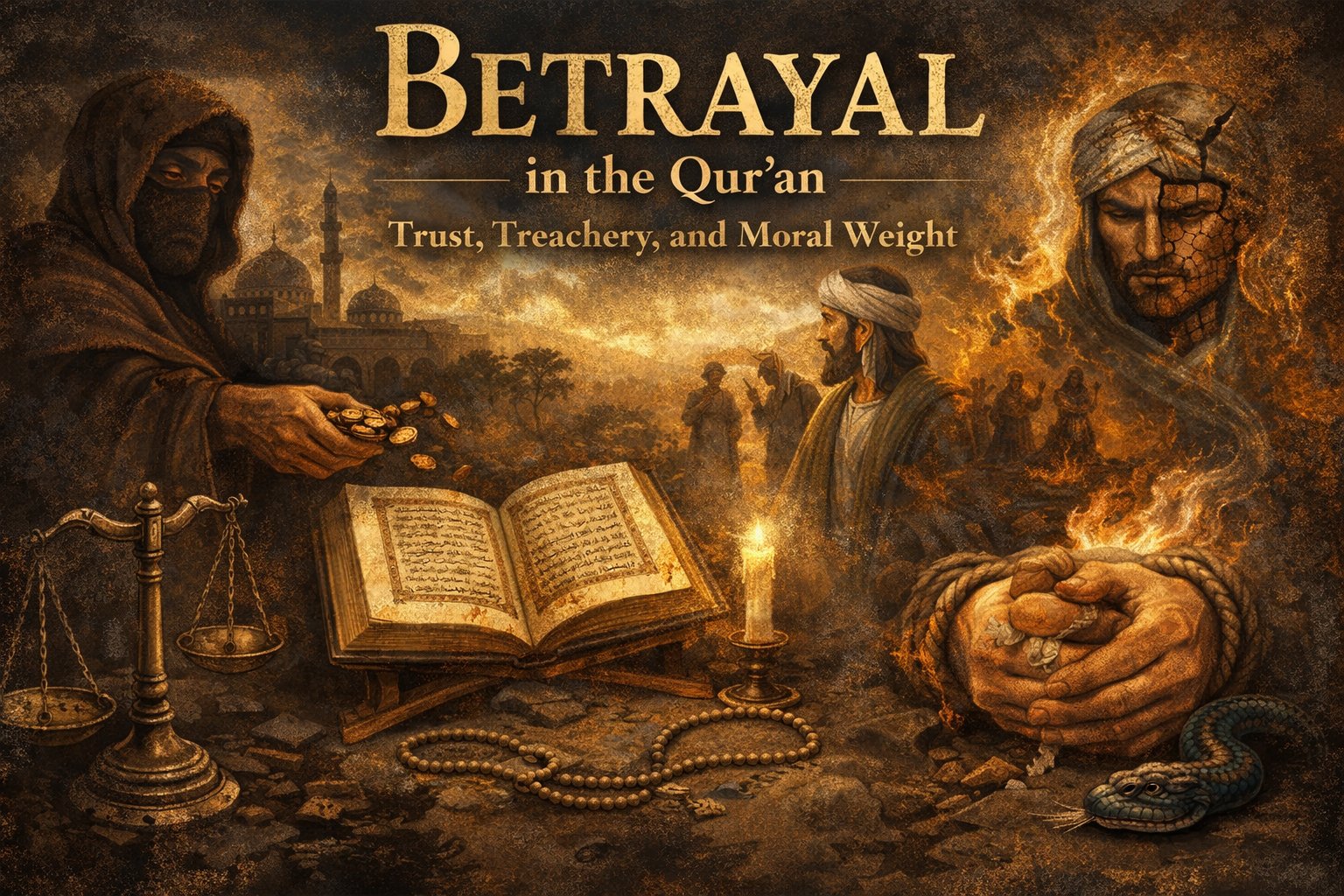
Betrayal in the Qur’an: Trust, Treachery, and Moral Weight
In the Qur’anic worldview, betrayal is not merely a social failing or interpersonal wrong. It is a violation of trust (amānah), a fracture in the moral architecture that binds individuals, communities, and humanity to God. Betrayal is treated not as an emotional accident, but as a deliberate moral choice one that corrodes character and destabilises justice.
Where the Bible often narrates betrayal through intimate personal stories, the Qur’an approaches betrayal through ethical principles, divine law, and moral consequence. Betrayal is universal, structural, and spiritually consequential.
The Core Concept: Khiyānah (خيانة)
The Qur’anic term most closely associated with betrayal is khiyānah, meaning treachery, deceit, or breach of trust.
Betrayal in Islam is fundamentally:
- A breach of trust entrusted by God
- A violation of moral responsibility
- A sign of inner corruption rather than situational weakness
“Indeed, Allah does not like the treacherous.”
(Qur’an 8:58)
This is a categorical moral statement. Betrayal is not contextualised away. It is universally condemned, regardless of who commits it or against whom.
Trust (Amānah) as a Divine Test
One of the Qur’an’s most profound moral claims is that trust itself is a divine burden:
“Indeed, We offered the Trust (amānah) to the heavens and the earth and the mountains, but they refused to bear it and feared it; and man undertook it.”
(Qur’an 33:72)
Here, betrayal is not merely interpersonal it is cosmic.
Human beings accepted moral agency, responsibility, and free will. Betrayal, therefore, is not ignorance it is the misuse of entrusted freedom.
In Qur’anic logic:
- To betray another person is to betray God
- To betray a covenant is to betray oneself
Betrayal Is Not Limited to Enemies
A striking Qur’anic principle is that betrayal is forbidden even against those who betray you.
“And do not let the hatred of a people prevent you from being just. Be just; that is nearer to righteousness.”
(Qur’an 5:8)
Justice in Islam is not reactive. Moral integrity does not collapse under emotional injury. Betrayal by others does not license betrayal in return.
This sharply contrasts with tribal or retaliatory ethics. In the Qur’an, faithfulness is independent of circumstances.
Betrayal Begins Internally
The Qur’an consistently locates betrayal not in opportunity, but in the state of the heart.
“They seek to deceive Allah and those who believe, but they deceive only themselves, though they do not perceive it.”
(Qur’an 2:9)
Betrayal is portrayed as:
- Self-deception before deception of others
- Moral blindness disguised as cleverness
- A symptom of spiritual disease (marad al-qalb)
This aligns closely with the Qur’anic psychology of sin: wrongdoing does not begin with action, but with distorted inner alignment.
Hypocrisy (Nifāq) as Institutional Betrayal
Perhaps the Qur’an’s harshest language is reserved for hypocrites those who outwardly profess loyalty while inwardly undermining trust.
“Indeed, the hypocrites will be in the lowest depths of the Fire.”
(Qur’an 4:145)
Why such severity?
Because hypocrisy is systemic betrayal:
- Betrayal of truth
- Betrayal of community
- Betrayal of moral coherence
The hypocrite weaponises trust. Their danger lies not in opposition, but in false proximity.
Prophets Betrayed: A Pattern, Not an Exception
The Qur’an recounts multiple instances of prophets being betrayed or rejected by their own people:
- Prophet Noah mocked by his community
- Prophet Moses betrayed by his people despite deliverance
- Prophet Muhammad ﷺ opposed by close kin and companions
Yet the Qur’an consistently shifts focus away from emotional grievance toward moral response.
Prophetic response to betrayal is marked by:
- Patience (ṣabr)
- Integrity (istiqāmah)
- Reliance on God (tawakkul)
Betrayal does not derail divine purpose it reveals moral alignment.
Divine Justice: Betrayal Always Returns to the Betrayer
The Qur’an is explicit: betrayal never escapes consequence.
“Whoever betrays will come with what he betrayed on the Day of Resurrection.”
(Qur’an 3:161)
This establishes a powerful moral symmetry:
- Betrayal carries its own weight
- The burden cannot be offloaded
- Accountability is inescapable
Unlike human justice, which may miss hidden treachery, divine justice is total.
Forgiveness Without Moral Confusion
The Qur’an permits forgiveness but never at the expense of moral clarity.
“But if you pardon and overlook and forgive then indeed, Allah is Forgiving, Merciful.”
(Qur’an 64:14)
Forgiveness is:
- A voluntary moral elevation
- Not a denial of wrongdoing
- Not an erasure of accountability
In Islamic ethics, forgiveness is strength, not naïveté. Trust may be withdrawn; forgiveness may still be granted.
Betrayal as a Measure of Faith
The Prophet Muhammad ﷺ summarised betrayal with piercing clarity:
“There is no faith for the one who is not trustworthy.”
In the Qur’anic framework:
- Faith is not belief alone
- Faith is ethical reliability
- Faith manifests as trustworthiness under pressure
Betrayal is therefore not a minor flaw it is a crack in faith itself.
Conclusion: Betrayal and Moral Gravity in the Qur’an
The Qur’an treats betrayal with uncompromising seriousness because it strikes at the foundation of moral life: trust.
Betrayal is:
- A violation of amānah
- A distortion of free will
- A failure of inner truthfulness
Yet the Qur’an also insists that betrayal never holds ultimate power. Integrity, justice, and divine accountability always outlast treachery.
In the Qur’anic vision, the betrayed are not defined by loss but by how they remain faithful when faithfulness is costly.
Betrayal exposes character.
Faithfulness defines it.
Leave a Reply