
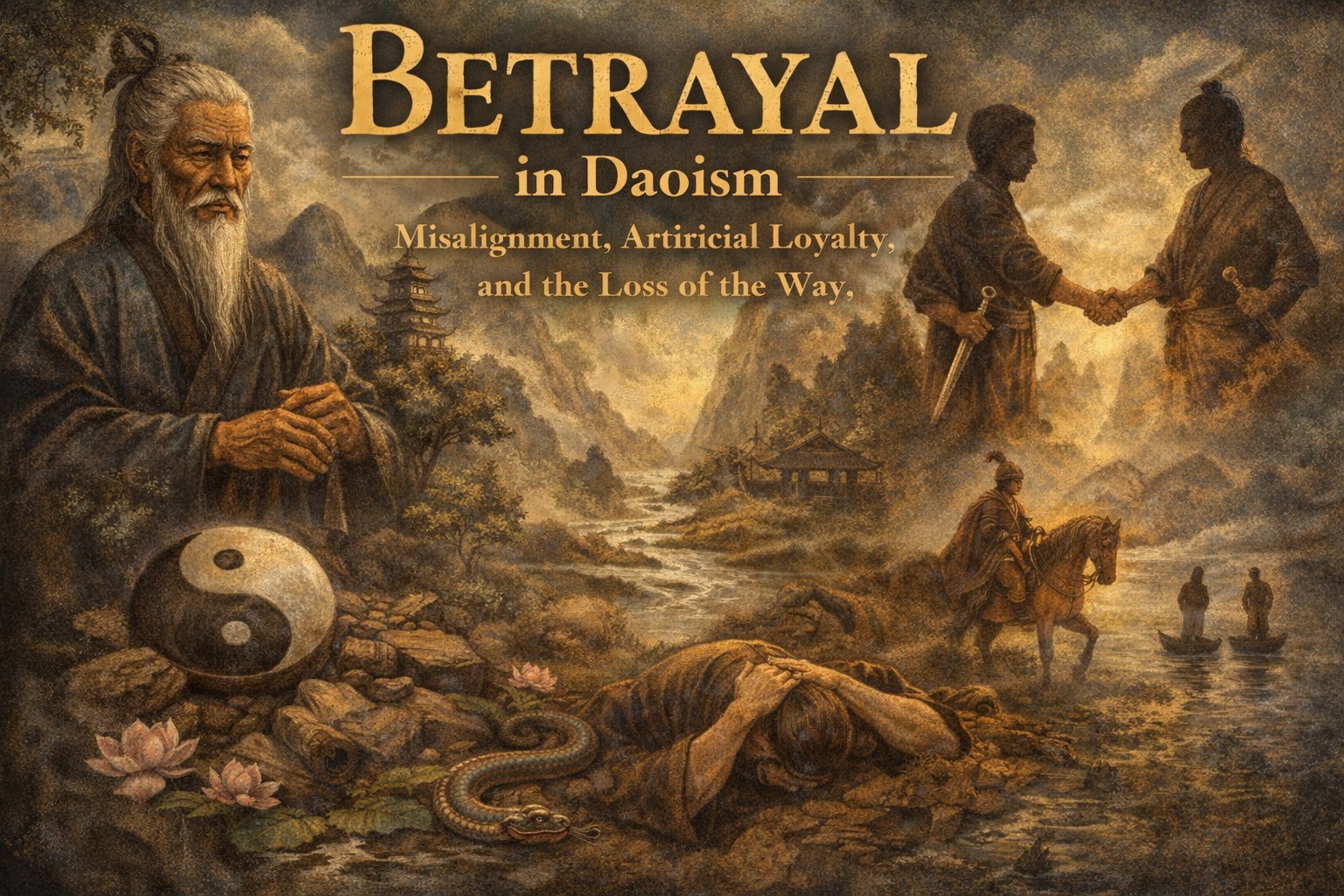
Betrayal in Daoism: Misalignment, Artificial Loyalty, and the Loss of the Way
Daoism does not frame betrayal as a sin, crime, or cosmic offence in the way many moral systems do. Instead, betrayal is understood as a symptom of deviation from the Dao (道) the natural Way by which all things unfold in balance.
In Daoist thought, betrayal is not primarily an ethical failure imposed from outside, but an internal fracture: the moment when human contrivance replaces natural harmony, when intention overrides attunement, and when rigid loyalty replaces spontaneous rightness.
Betrayal, therefore, is not dramatic rebellion. It is unnatural effort.
Dao Over Loyalty
Daoism does not elevate loyalty as an absolute virtue. Loyalty becomes dangerous when it hardens into attachment.
The Dao De Jing warns against artificial virtues:
“When the Dao is lost, there is virtue.
When virtue is lost, there is righteousness.
When righteousness is lost, there is propriety.”
(Dao De Jing, ch. 38)
From a Daoist perspective, betrayal arises after the Dao has already been lost. When relationships require enforcement, vows, or rigid moral policing, harmony has already collapsed.
True alignment does not need loyalty declarations.
It moves effortlessly.
Betrayal as Forced Behaviour
Daoism identifies forced consistency as the root of betrayal.
When people act:
- Against their nature
- Beyond their capacity
- In contradiction to changing circumstances
They eventually fracture.
Betrayal occurs not because people are evil, but because they are overextended, misaligned, or trapped in roles they cannot sustain.
Zhuangzi repeatedly mocks rigid moral roles officials who betray kings, students who betray teachers not to condemn them, but to reveal that the original arrangement was already unnatural.
The Danger of Fixed Identity
Daoism rejects fixed identity. One who clings to a role friend, servant, disciple, ruler will eventually betray it, because the world does not remain fixed.
“Flow with whatever may happen, and let your mind be free.”
(Zhuangzi)
Betrayal emerges when identity is frozen:
- “I must always be this”
- “I can never change”
- “I owe loyalty beyond my nature”
Daoism sees betrayal as the cost of pretending permanence in a transient world.
Wu Wei and the Absence of Betrayal
Wu wei (無為) often misunderstood as inaction means non-forced action, action in harmony with the Dao.
Where wu wei governs behaviour:
- There is no betrayal
- There is no dramatic rupture
- There is quiet, organic separation when alignment ends
Daoism prefers natural departure over forced loyalty.
A relationship that ends without drama is not betrayal it is completion.
Betrayal and Moral Drama
Daoism distrusts moral drama. The louder the accusation of betrayal, the further one has drifted from the Dao.
Zhuangzi observes that:
- Those who shout about loyalty are already unstable
- Those who moralise betrayal are protecting fragile identities
Daoism does not ask:
“Who betrayed whom?”
It asks:
“Where did harmony cease?”
Power, Hierarchy, and Inevitability
Daoist political philosophy assumes that betrayal in hierarchical systems is inevitable.
When power accumulates:
- Fear increases
- Control tightens
- Spontaneity dies
Betrayal then becomes predictable not immoral, but mechanical.
“The more laws and restrictions there are, the poorer people become.”
(Dao De Jing, ch. 57)
Betrayal, in this view, is the shadow cast by over-control.
The Sage Is Never Betrayed
In Daoism, the sage avoids betrayal not by controlling others, but by expecting nothing unnatural.
The sage:
- Does not bind others with obligation
- Does not demand permanence
- Does not confuse closeness with ownership
Because expectations are light, betrayal has no soil to grow in.
“He trusts those who are trustworthy;
he also trusts those who are not trustworthy.”
(Dao De Jing, ch. 49)
This is not naïveté it is freedom from illusion.
Betrayal as Resistance to Change
At its deepest level, Daoism frames betrayal as resistance to transformation.
When:
- Rivers change course
- Seasons turn
- People evolve
Attempting to freeze loyalty is an act of violence against the Dao.
What appears as betrayal is often life continuing despite human preference.
Conclusion: Betrayal Is Not the Problem Misalignment Is
Daoism does not ask us to punish betrayal, forgive betrayal, or even judge betrayal.
It asks us to observe:
- Where we forced loyalty
- Where we ignored natural limits
- Where we mistook attachment for harmony
In Daoism, betrayal is not a moral failure it is a diagnostic signal.
Something has gone out of alignment.
The Dao does not accuse.
It adjusts.
Those who move with it experience no betrayal only change.
Leave a Reply