
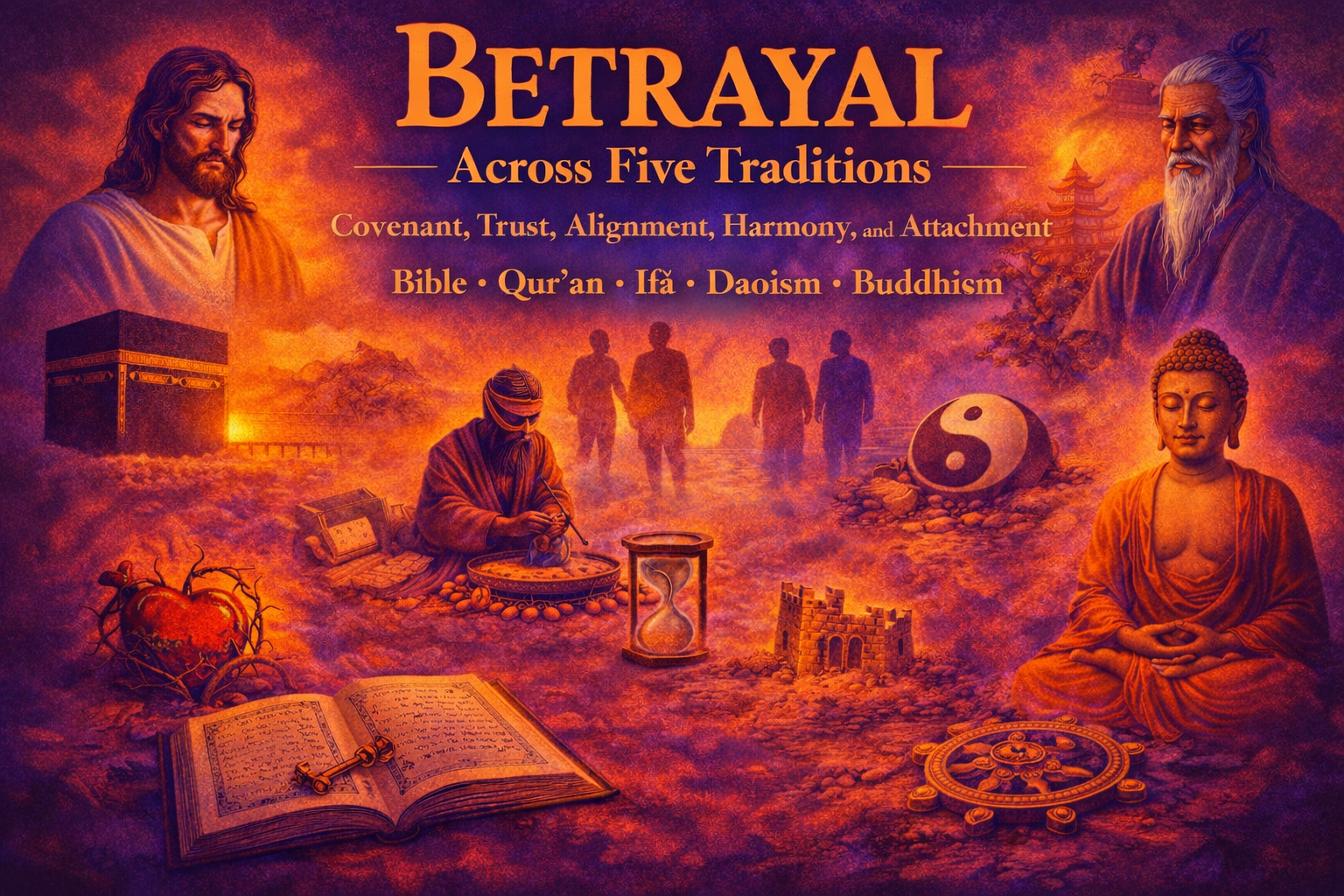
Betrayal Across Five Traditions: A Reflective Synthesis (Bible • Qur’an • Ifá • Daoism • Buddhism)
Across this chat, betrayal has appeared in five different moral universes but the same wound keeps showing up: trust collapses, and the human heart scrambles to explain what just happened. Each tradition agrees betrayal is serious, yet they disagree on what betrayal is, what it damages, and what the “right” response looks like.
The most useful way to compare them is to ask one repeating set of questions:
- What is being broken?
- What causes it?
- What does it reveal?
- What restores order if anything can?
Below is a detailed reflective map, drawing directly from the logic we established in each piece.
What Betrayal Is in Each Tradition
Bible: Betrayal as Covenant Rupture
In the biblical frame, betrayal is not merely disloyalty. It is violating covenant, especially when intimacy exists (“shared my bread”). Betrayal is relational and moral a breach of what love promised to be. It’s why Judas hurts more than a stranger.
Core idea: betrayal is treachery inside closeness an inner-circle fracture that tests faithfulness.
Qur’an: Betrayal as Breach of Amānah (Trust Entrusted by God)
In the Qur’anic frame, betrayal is khiyānah treachery as violation of trust. But that trust is not only social: it is a divine responsibility, a burden humanity accepted. Betraying people is not separate from betraying the moral order.
Core idea: betrayal is not just personal harm; it is failure of moral reliability before God.
Ifá: Betrayal as Misalignment with Orí (Destiny) and Ìwà (Character)
In Ifá, betrayal is primarily rupture of alignment with your character and destiny before birth. It is not only “wrong” but spiritually incoherent. Ifá doesn’t ask first “what rule was broken?” but “what alignment was abandoned?”
Core idea: betrayal is character collapsing into misalignment, and destiny records it.
Daoism: Betrayal as the Symptom of Artificial Loyalty
Daoism is the odd one out: it refuses to treat betrayal as the primary problem. Betrayal is framed as a sign that harmony was already lost that people were living through force, attachment, and rigid roles rather than attunement to the Dao.
Core idea: betrayal is unnatural effort revealed a fracture caused by forcing permanence in a changing world.
Buddhism: Betrayal as a Teacher of Impermanence and Attachment
Buddhism shifts the centre again: betrayal is understood through delusion and clinging. The pain is real, but it is intensified by attachment to permanence, identity, and ownership. Betrayal becomes a mirror showing where the mind was gripping too tightly.
Core idea: betrayal is clinging collapsing under reality impermanence arriving suddenly.
What Each Tradition Says Betrayal Breaks
This is where the five traditions diverge most clearly.
- Bible: betrayal breaks relationship + covenant (love violated)
- Qur’an: betrayal breaks trust as a divine responsibility (amānah)
- Ifá: betrayal breaks alignment with destiny and communal order
- Daoism: betrayal reveals that harmony was already broken (too much force)
- Buddhism: betrayal breaks illusion it shatters the fantasy of permanence and possession
A single act looks different depending on what you believe holds society together:
- If you think society is held by covenant, betrayal is sacrilege.
- If you think it’s held by trustworthiness, betrayal is moral rot.
- If you think it’s held by alignment, betrayal is spiritual incoherence.
- If you think it’s held by harmony, betrayal is a symptom of over-control.
- If you think it’s held by non-clinging wisdom, betrayal is painful awakening.
The Shared Engine: What Drives Betrayal
Despite different metaphysics, all five narratives converge on a single theme:
Betrayal is rarely sudden; it is usually preceded by internal drift.
In our Bible response: “small compromises,” “hardened resentment,” “rationalised disobedience.”
In the Qur’an response: deception begins as self-deception.
In Ifá: betrayal grows from misaligned character.
In Daoism: betrayal comes from forced behaviour and roles people cannot sustain.
In Buddhism: betrayal erupts from greed, hatred, delusion states of mind.
So across five traditions, betrayal is not “a random act.”
It is a visible crack produced by an invisible fracture.
Betrayal as Revelation: What It Exposes
Each tradition treats betrayal as a kind of X-ray.
Bible
Betrayal reveals the difference between human faithfulness and divine faithfulness. It magnifies God’s steadfast love because betrayal is the dark thread that makes the light visible.
Qur’an
Betrayal reveals hypocrisy and moral incoherence. It separates outward performance from inward truth.
Ifá
Betrayal reveals the state of ìwà and the witness of orí. Betrayal is diagnostic.
Daoism
Betrayal reveals where harmony ceased where forcing replaced flow.
Buddhism
Betrayal reveals attachment. It exposes where love became possession.
Across all five, betrayal is a revelation event.
Justice, Consequence, and the Return
All five traditions affirm consequence, but they imagine it differently.
- Bible: consequence exists, but redemption can outlast it
- Qur’an: divine accountability is total
- Ifá: consequence is metaphysical and timed
- Daoism: consequence is imbalance correcting itself
- Buddhism: consequence is karma shaped by intention
Across all five: betrayal is never free.
Forgiveness, Release, and Restoration
The traditions offer a gradient:
- Bible: forgiveness as costly transformation
- Qur’an: forgiveness without moral confusion
- Ifá: restoration is possible but not cheap
- Daoism: quiet completion over forced loyalty
- Buddhism: letting go as liberation
Each offers a different wisdom for healing without denial.
The Deep Convergence: Misplaced Ultimacy
Across all five traditions:
Betrayal happens when something that is not ultimate is treated as ultimate.
- Money over covenant
- Self-interest over trust
- Ego over destiny
- Permanence over change
- Attachment over truth
Betrayal is often a religious error disguised as a social one.
A Unified Ekelola Lens: Fracture, Then Invitation
Across all five traditions, betrayal unfolds in two stages:
Stage 1: Fracture
- Covenant ruptures
- Trust breaks
- Alignment collapses
- Harmony dissolves
- Clinging shatters
Stage 2: Invitation
- Deeper faithfulness
- Moral reliability
- Destiny realignment
- Non-forced living
- Non-clinging wisdom
Closing Reflection
Across Bible, Qur’an, Ifá, Daoism, and Buddhism, betrayal is never just “someone did something bad.”
It is a moment where reality speaks:
- Covenant was not honoured.
- Trust was mishandled.
- Destiny was ignored.
- Harmony was forced.
- Attachment was exposed.
Different metaphysics same revelation.
Betrayal does not merely break relationships.
It reveals what was holding them together.
Leave a Reply