
Productivity Is Not Effort
Productivity is one of the most misunderstood words in economics.
It is often confused with busyness, hard work, or long hours.
But productivity is not about effort. It is about conversion.
In economic terms, productivity asks a simple question:
How much useful output do you generate from the inputs you already have?
The inputs might be labour, time, capital, tools, energy, or knowledge.
The output might be goods, services, value, or finished work.
Productivity measures the ratio, not the struggle.
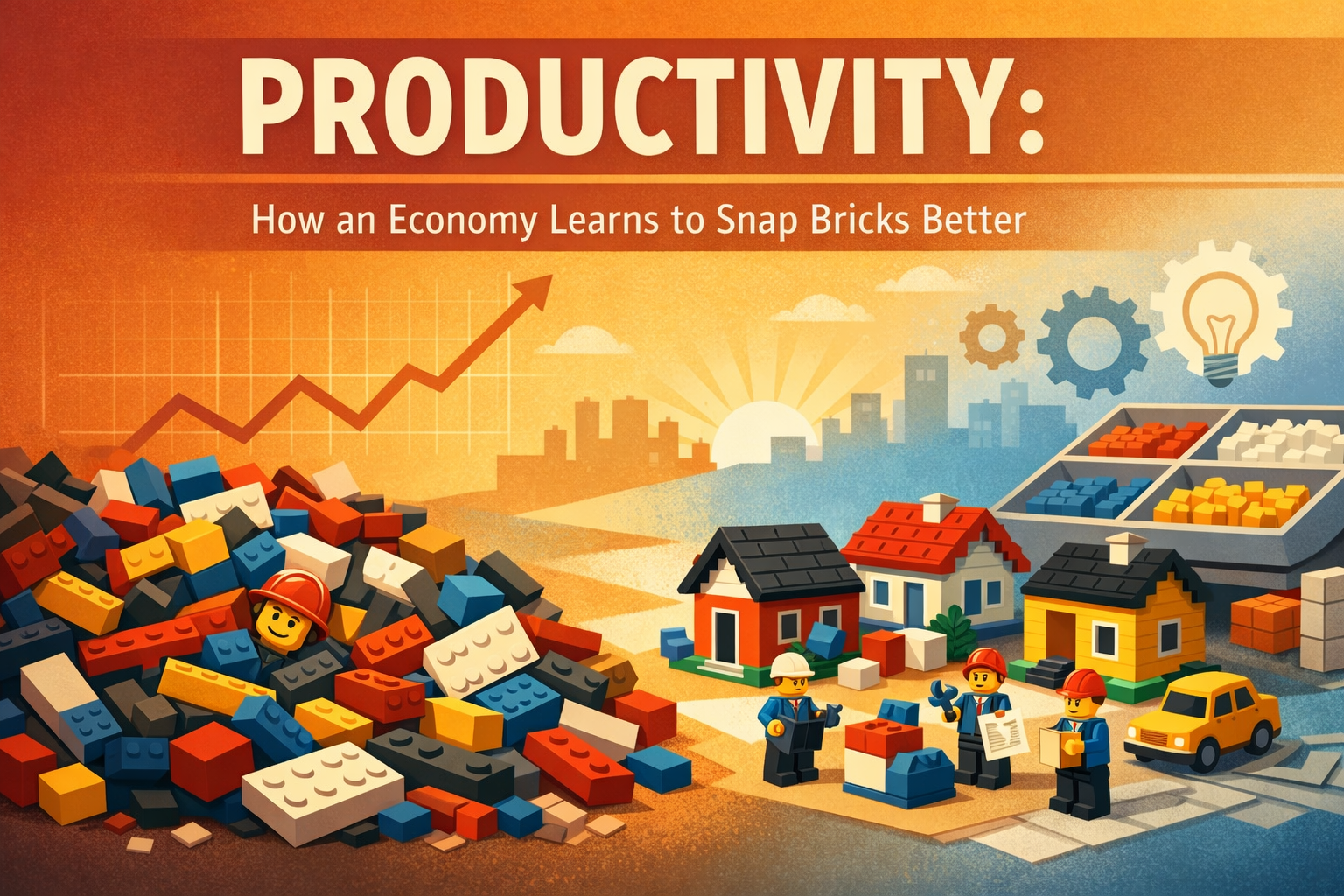
The LEGO Workshop Economy
Imagine an economy as a vast LEGO workshop.
Everyone has bricks.
Everyone has hands.
Everyone has the same amount of time.
The difference between a poor economy and a wealthy one is not the number of bricks.
It is how the bricks are organised, combined, and snapped together.
In a low-productivity workshop:
- Bricks are piled randomly
- Builders search more than they build
- Instructions are unclear or missing
- Mistakes are rebuilt repeatedly
After a full day, there is very little to show for the effort.
The builders are tired.
But tiredness does not equal value.
Same Bricks, Different Outcomes
Now imagine the same workshop, with the same bricks and the same builders.
But this time:
- Bricks are sorted by type
- Roles are clearly defined
- Instructions are shared
- Techniques are refined
Nothing mystical has changed.
No new bricks were added.
Yet the output multiplies.
This is productivity.
Not more inputs.
Better arrangement of the same inputs.
Why Working Harder Rarely Solves It
When productivity stalls, the instinctive response is pressure.
“Work longer.”
“Work faster.”
“Try harder.”
But if the LEGO pieces are still unsorted, more effort only increases exhaustion.
In economic terms:
- Longer hours without better systems lead to diminishing returns
- Burnout replaces innovation
- Wages stagnate because output per hour does not rise
Effort without leverage simply stretches the same inefficiency over more time.
Productivity at the National Scale
At the level of a country, productivity determines almost everything that matters:
- Wage growth
- Living standards
- Economic resilience
- The ability to absorb shocks
A productive economy allows people to earn more without prices spiralling upward.
An unproductive economy can only grow by inflating hours, debt, or extraction.
This is why productivity is the quiet engine of wealth.
It does not shout.
It compounds.
The Myth of “More Bricks”
Adding more resources increases scale, not productivity.
If you double the number of LEGO bricks but keep the same chaotic process, you get:
- Bigger piles
- Larger messes
- Marginally better results
True productivity gains come from:
- Better tools
- Better training
- Better coordination
- Better knowledge transfer
In other words: better snapping, not bigger piles.
Productivity and Power
Productivity is also political.
An economy that learns to produce more with less gains leverage:
- In trade
- In wages
- In diplomacy
- In technological leadership
This is why productivity gaps translate into power gaps over time.
The workshop that learns faster methods builds cities.
The one that relies on brute effort keeps rebuilding huts.
The Boring Revolution
Most productivity gains are unglamorous:
- Cleaner workflows
- Incremental automation
- Small process improvements
- Shared standards
They rarely feel revolutionary in the moment.
But over decades, they redraw the map.
One improved snap technique today
becomes an entire LEGO metropolis tomorrow.
A Precise Definition
In its cleanest form:
Productivity is the intelligence with which an economy combines what it already has.
Not how hard it works.
Not how long it toils.
But how well it understands the system it is building.
Closing Thought
Every economy has bricks.
Every society has builders.
The difference between stagnation and prosperity is not moral virtue or effort.
It is whether the system learns how to snap the bricks together better —
and then teaches everyone else how to do the same.
Leave a Reply