
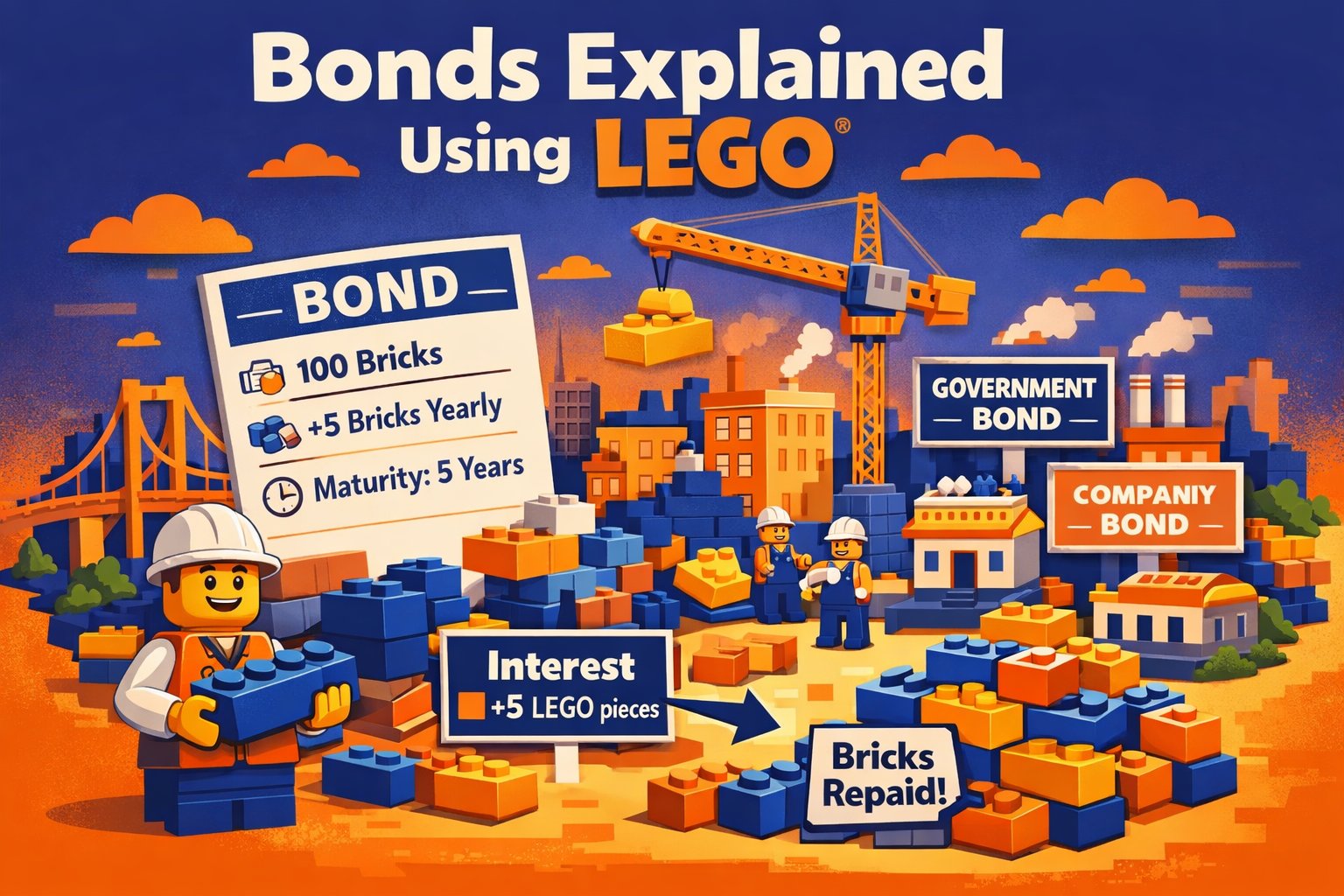
Bonds Explained Using LEGO 🧱
Most explanations of bonds fail because they start with abstraction: yields, coupons, maturities, basis points.
Instead, let’s start with something concrete.
Imagine money is LEGO bricks.
And imagine big economic projects are LEGO cities.
Governments and companies want to build large LEGO cities bridges, hospitals, railways, factories, data centres. These projects are expensive, slow, and long-term. They require a lot of bricks, all at once.
But builders don’t always have enough bricks upfront.
That’s where bonds come in.
1. What a Bond Really Is
A bond is not complicated. It is a structured promise that says:
“Give me your LEGO bricks now.
I’ll pay you a small, regular rent for using them.
And after a fixed amount of time, I’ll return all your bricks.”
So when you buy a bond:
- You are lending, not investing in ownership
- You are not guessing outcomes
- You are entering a time-bound agreement
In LEGO terms:
- You lend LEGO bricks
- Someone else builds something productive
- You receive steady rewards
- You eventually get your original bricks back
No mystery. Just terms.
2. The Three Core Players
🧍 The Investor (You)
You have LEGO bricks sitting idle.
You’re not using them right now, but you don’t want them wasted.
You could:
- Leave them on the floor (cash)
- Gamble with them (stocks)
- Or rent them out safely (bonds)
🏗️ The Builder (Government or Company)
The builder needs many bricks from many people.
Borrowing from one person would be too slow and risky.
So they issue thousands or millions of identical instruction cards each one representing a bond.
📜 The Instruction Card (The Bond Itself)
The bond is the rulebook.
It clearly states:
- How many bricks you lend (principal)
- How often you’ll be paid (interest schedule)
- How much rent you’ll receive (coupon rate)
- When the bricks must be returned (maturity date)
This clarity is the entire appeal of bonds.
3. Interest = LEGO Rent
Interest is simply rent for borrowed bricks.
If you lend:
- 100 LEGO bricks
- And the bond pays 5 bricks per year
Then:
- Your interest rate is 5%
- You receive your rent whether the city is beautiful or ugly
- You are not exposed to profits or losses beyond default risk
Unlike stocks, performance doesn’t matter only the builder’s ability to honour the promise.
4. Maturity: When the Build Ends
Every LEGO project has an end date.
In bonds, this is called maturity.
At maturity:
- The builder returns all your original bricks
- The rent stops
- The contract ends cleanly
Short maturity = quick projects
Long maturity = infrastructure, highways, nations planning decades ahead
5. Why People Buy Bonds
Bonds exist because not everyone wants excitement.
What bonds offer:
- Predictability
- Stability
- Cash flow
- Capital preservation
They are not designed to make you rich fast.
They are designed to not surprise you.
In portfolios, bonds are often:
- The ballast
- The shock absorbers
- The sleep-at-night asset
6. Government Bonds vs Company Bonds
🏛️ Government Bonds
- Issued by the largest LEGO builder in the country
- Can raise taxes or print money if needed
- Extremely unlikely to vanish
- Lower LEGO rent
- High trust
These are considered low-risk bricks.
🏭 Corporate Bonds
- Issued by companies
- Higher LEGO rent
- More dependent on business health
- Higher risk of failure
- Greater reward for taking that risk
Risk and reward always trade places.
7. Bond Prices (The Part Everyone Finds Confusing)
You don’t have to wait until maturity.
You can sell your bond’s instruction card to someone else.
Now supply and demand enter the picture.
If:
- Your bond pays high LEGO rent
- And new bonds pay less
Then:
- Your instruction card becomes valuable
- People pay more bricks to own it
If:
- New bonds pay better rent than yours
Then:
- Your bond becomes less attractive
- Its price falls
This leads to the key rule:
Interest rates rise → bond prices fall
Interest rates fall → bond prices rise
Same LEGO bricks.
Same promise.
Different market conditions.
8. Bonds vs Stocks (LEGO Comparison)
| Bonds | Stocks |
|---|---|
| Lending LEGO bricks | Owning part of the LEGO factory |
| Fixed rent | Variable profits |
| Known outcomes | Uncertain outcomes |
| Lower risk | Higher risk |
| Time-bound | Open-ended |
Stocks reward belief.
Bonds reward patience.
9. The Deeper Truth About Bonds
Bonds are not exciting because they are not stories.
They are contracts.
They reflect:
- Trust in institutions
- Belief in continuity
- Confidence that tomorrow will resemble today enough to repay yesterday’s promises
When bonds fail, it is rarely a financial problem.
It is almost always a political, structural, or moral one.
One-Sentence Summary
A bond is lending your LEGO bricks to a builder in exchange for steady rent and a guaranteed return of your bricks at a fixed time.
Leave a Reply