
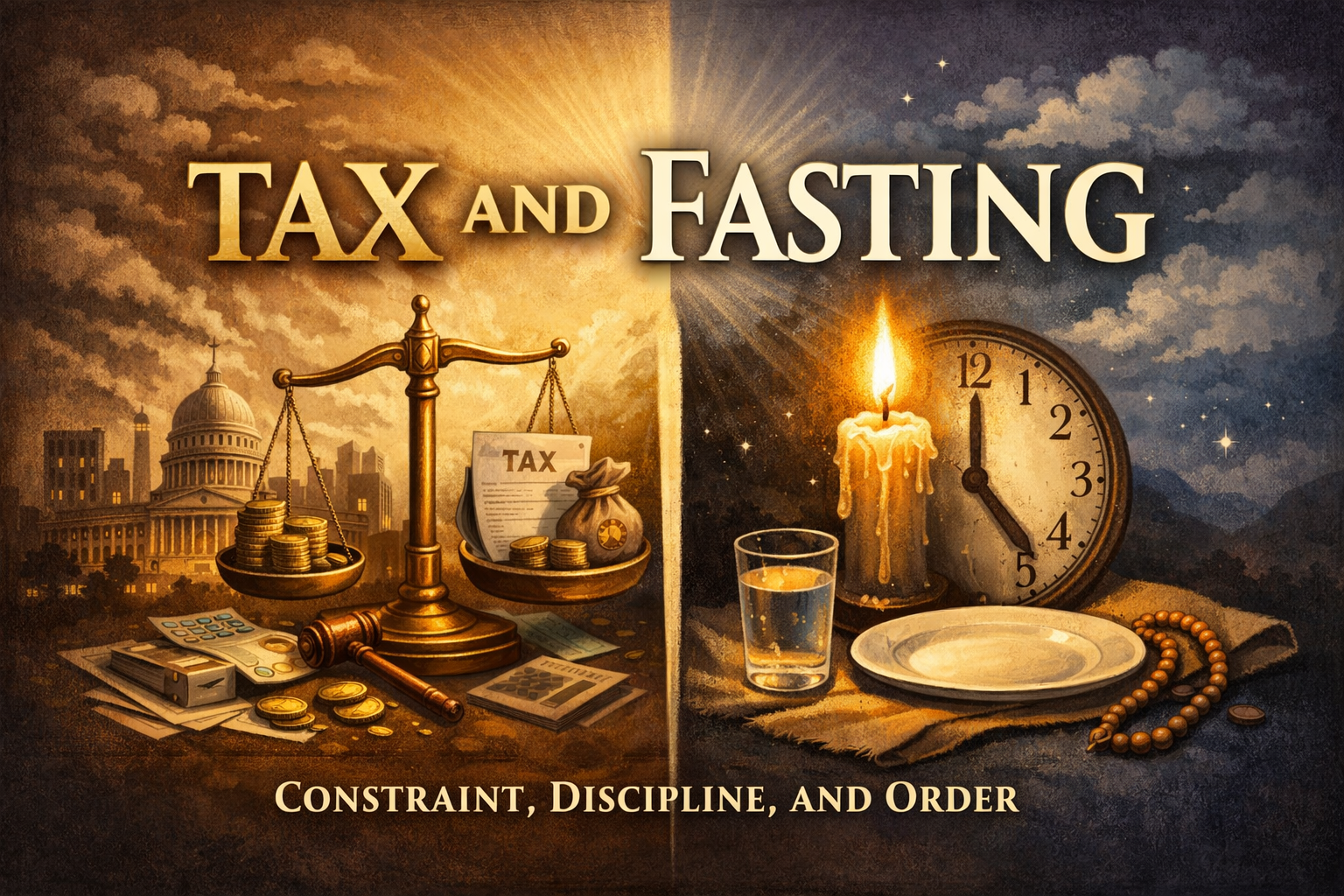
Here’s a conceptual comparison of tax and fasting not as policies or rituals alone, but as mechanisms that shape behaviour, discipline desire, and structure society.
At a Glance
| Dimension | Tax | Fasting |
|---|---|---|
| Nature | External obligation | Internal discipline |
| Enforcement | Coercive (law, penalty) | Voluntary (or spiritually compelled) |
| Domain | Economic / civic | Biological / spiritual |
| Pain point | Loss of resources | Withholding of consumption |
| Purpose | Collective order | Personal transformation |
| Failure mode | Evasion, avoidance | Hypocrisy, vanity |
1. External vs Internal Constraint
Tax is imposed from the outside.
It does not ask whether you agree only whether you comply.
Fasting is imposed from within.
Even when culturally or religiously mandated, its effectiveness depends on inner consent.
Tax disciplines behaviour through fear of consequence.
Fasting disciplines behaviour through mastery of desire.
2. Extraction vs Restraint
Tax takes something you possess money, time, productivity.
Fasting denies something you could consume food, pleasure, comfort.
This difference matters:
- Tax is about redistribution
- Fasting is about reorientation
One reallocates resources.
The other recalibrates appetite.
3. Collective Order vs Personal Order
Tax exists to sustain systems larger than the individual:
- Infrastructure
- Security
- Welfare
- Governance
Fasting exists to reorder the individual themselves:
- Body over appetite
- Mind over impulse
- Spirit over habit
Tax asks: “What do you owe society?”
Fasting asks: “What controls you?”
4. Compliance vs Transformation
A person can pay tax and remain unchanged.
A person cannot truly fast and remain the same.
- Tax compliance does not require belief.
- Fasting without inner change is hollow.
This is why fasting traditions often warn:
“If you only starve the body, you’ve missed the point.”
5. Visibility vs Hiddenness
Tax is visible:
- Payslips
- Returns
- Audits
- Receipts
Fasting is meant to be invisible:
- No applause
- No ledger
- No public scorecard
Where tax produces records, fasting produces character.
6. Failure and Corruption
Tax fails when:
- The burden is unjust
- Funds are misused
- People evade or exploit loopholes
Fasting fails when:
- It becomes performative
- It feeds ego rather than humility
- The body is denied but the heart remains indulgent
Both systems collapse when trust is broken:
- Trust in institutions (tax)
- Trust in intention (fasting)
7. Power Dynamics
Tax is an expression of state power.
It reminds you: you are part of something that can compel you.
Fasting is an expression of self-power.
It reminds you: you are not ruled by impulse.
One subordinates the individual to the collective.
The other strengthens the individual against themselves.
8. A Deeper Parallel
At their best:
- Tax teaches that ownership is not absolute.
- Fasting teaches that desire is not sovereign.
Both say:
“You do not get to keep or consume everything you could.”
But they diverge in spirit:
- Tax says: “You must give.”
- Fasting says: “You must choose not to take.”
Final Distinction
Tax builds civilisation.
Fasting builds the person capable of sustaining one.
A society without tax collapses into chaos.
A society without fasting collapses into excess.
One governs wealth.
The other governs the self.
And when either is absent or corrupted the cost is always higher than it appears.
Leave a Reply