
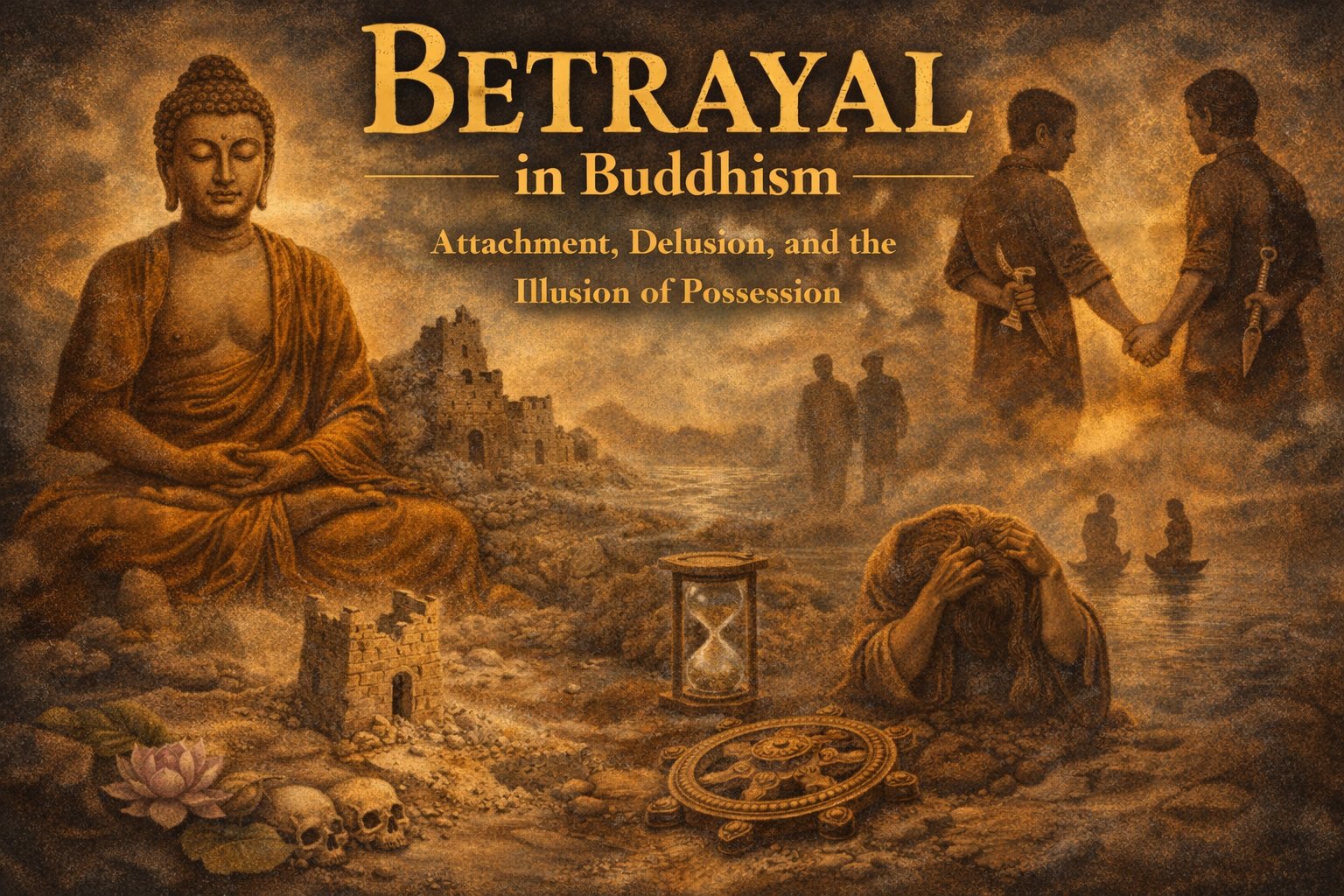
Betrayal in Buddhism: Attachment, Delusion, and the Illusion of Possession
In Buddhism, betrayal is not framed as a sin against a divine lawgiver, nor primarily as a moral violation between fixed selves. Instead, betrayal is understood as a manifestation of delusion (avijjā), arising from attachment (taṇhā), craving, and the mistaken belief in permanence where none exists.
From a Buddhist perspective, betrayal is less about someone “turning against” another, and more about clinging collapsing under reality. What hurts is not the act alone, but the illusion that something stable was ever owned, secured, or guaranteed.
No-Self (Anattā) and the Roots of Betrayal
Buddhism begins with a radical premise: there is no permanent self.
When betrayal is experienced, it is often felt as:
- “You violated who we were”
- “You broke what we had”
- “You turned against me“
But Buddhism gently dismantles this framing. If there is no fixed self, and no permanent “other,” then betrayal is not a metaphysical rupture it is a psychological shock caused by attachment to identity.
The Buddha teaches that suffering (dukkha) arises not from change itself, but from resistance to change.
Betrayal wounds because it exposes impermanence that was already present but ignored.
Attachment (Taṇhā) as the True Source of Pain
In Buddhist analysis, betrayal is painful because of attachment, not because of moral shock.
Attachment takes many forms:
- Attachment to people remaining consistent
- Attachment to roles (friend, partner, disciple)
- Attachment to expectations of loyalty
When attachment meets impermanence, suffering arises.
The Buddha does not deny that harm occurs. But he insists that the intensity of suffering corresponds directly to the strength of clinging.
Betrayal is thus not a standalone cause of suffering it is a revealer of attachment already present.
Intention (Cetanā) and Moral Weight
While Buddhism avoids moral absolutism, it does not ignore ethics. The moral dimension of betrayal is assessed through intention.
“It is intention that I call karma.”
(Anguttara Nikāya)
A betrayal motivated by:
- Greed
- Hatred
- Delusion
Generates unwholesome karma.
But betrayal arising from confusion, fear, or ignorance is treated differently from betrayal rooted in cruelty or manipulation.
Buddhism is less concerned with judging the act and more concerned with understanding the mental states that produced it.
Betrayal as Ignorance, Not Evil
Unlike systems that frame betrayal as moral rebellion, Buddhism frames it as ignorance in action.
A person who betrays is:
- Acting from confusion
- Mistaking short-term relief for long-term peace
- Trying to escape discomfort through harmful means
This does not excuse betrayal but it reframes it.
Hatred toward the betrayer compounds suffering. Understanding weakens it.
“Hatred is never appeased by hatred.
By non-hatred alone is hatred appeased.”
(Dhammapada)
Expectation as a Subtle Form of Violence
Buddhism places quiet emphasis on expectation as a root of suffering.
To expect permanence from an impermanent being is, in Buddhist terms, misaligned perception.
Betrayal shocks because it violates expectation but Buddhism questions whether the expectation itself was ever reasonable.
This does not mean relationships are meaningless. It means they are conditional, momentary, and dynamic.
Wisdom does not demand loyalty guarantees.
It cultivates presence without ownership.
Right Speech, Right Action, and Betrayal
Within the Eightfold Path, betrayal is understood as a failure of:
- Right Speech (deception, concealment)
- Right Action (harmful conduct)
- Right Livelihood (when betrayal is systemic or exploitative)
But Buddhism treats these failures as training errors, not permanent stains.
The response is not condemnation, but mindful correction.
Compassion for the Betrayer and the Betrayed
Buddhism extends compassion in both directions.
For the betrayed:
- Suffering is acknowledged
- Pain is not dismissed
- Healing begins with non-clinging
For the betrayer:
- Their karma continues
- Their suffering is not avoided
- Their ignorance carries consequence
Compassion does not mean reconciliation.
It means freedom from hatred.
Letting Go as Liberation
Ultimately, Buddhism offers no dramatic moral resolution to betrayal.
It offers release.
When one sees clearly that:
- All conditioned things are impermanent
- All attachments carry seeds of loss
- No person can guarantee permanence
Then betrayal loses its existential sting.
What remains is sadness without bitterness, clarity without resentment, and wisdom without illusion.
Conclusion: Betrayal as a Teacher of Impermanence
In Buddhism, betrayal is not an enemy it is a teacher.
It teaches:
- Impermanence (anicca)
- Non-self (anattā)
- The unsatisfactory nature of clinging (dukkha)
Betrayal hurts because it reveals truth suddenly instead of gradually.
The awakened response is not blame, nor denial, but insight.
When attachment dissolves, betrayal has nowhere to land.
There is loss.
There is pain.
But there is no enemy.
Only the Way unfolding.
Leave a Reply